














join the
6-7-8 Book Club
apply To be a SSFP Student Writer (waiting list)
apply To the Summer Media Institute
download our
curriculum guide
ssfp FAQ's
|
Secrets Locked in Ancient Ice
UW Researchers Drill Two Miles Below Antarctica’s Ice Sheet
by Alex Lee, age 15

For almost three years Charles Bentley has been digging a hole.
Bentley, 81, has been researching Antarctica for almost 50 years. Bentley is a UW-Madison researcher and the principal investigator for the Ice Drilling Design Operations group with the UW-Madison Space Science and Engineering Center.
Wisconsin researchers began drilling through Antarctic ice more than two years ago to retrieve ice cores for climate studies. On New Year’s Eve, of last year they drilled to a record depth of about two miles (11,171.3 feet), breaking the previous record of 10,928 feet. This ended the first phase of that project.
The researchers are working in an extremely remote area of West Antarctica. One goal of these scientists is to get as close as possible to the bottom of the two-mile deep glaciers that cover this part of Antarctica. The scientists slept in tents and dealt with difficult technical challenges every day, including equipment failure and the threat of the borehole caving in. A borehole is a hole used to extract water, gas, or ice from the ground. As the drill goes deeper, the weight of the ice above increases, threatening to collapse the hole and crush the drill.
In an interview with Wisconsin State Journal reporter, Ron Seely, Bentley said that the ice cores themselves are the most interesting to him. The ice brought up from record-breaking depths reached last year is about 43,000 years old. If they reach the very bottom of the ice sheet, scientists could be looking at ice core samples as much as 100,000 years old.
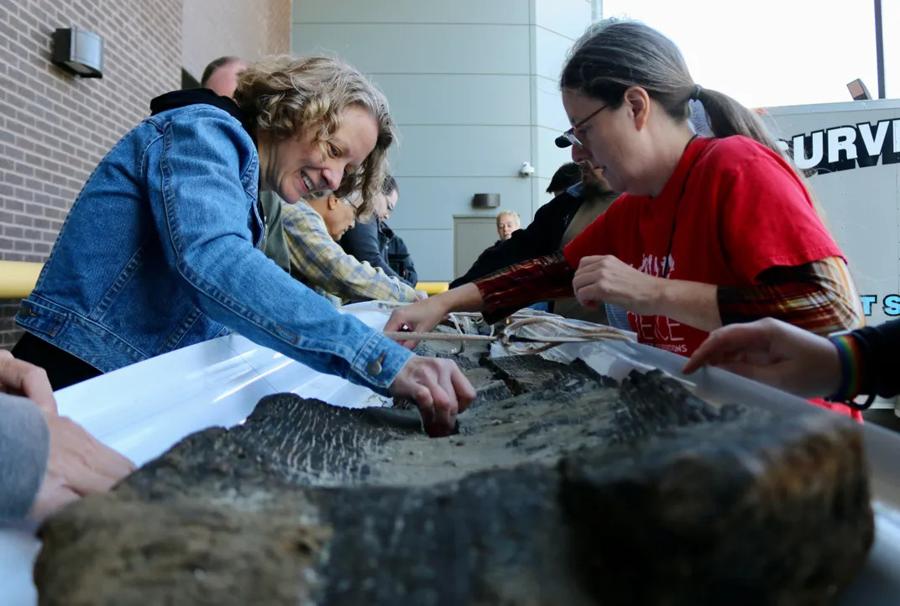
The researchers pack these ice cores in small sections and ship them to the National Ice Core Laboratory in Denver. In each section, machines store the air inside the ice, first crushing the ice and then capturing the air that comes out. Researchers can learn a lot from this air, including what the climate was like at specific times in the past. According to Bentley, the cores are providing ancient weather reports.
This research does not allow scientists to observe climate changes in places like Antarctica, but it helps to prove that there is a warming trend from the ice of the past. The second phase of Bentley’s project started at the beginning of this month. Bentley’s team is searching for extra ice at depths where interesting climatic events have been recorded.
So far there is not enough of this ice to meet the demand of scientists who wish to study it. The existing ice hole will provide the scientists with the ice that is needed. When retrieving the ice, Bentley’s team will have to drill sideways out of the main hole, employing a unique technique called deviation drilling. But in order for scientists to start deviation drilling, their drill must be modified. These modifications are being tested right now by their crew in West Antarctica.
[Sources: Wisconsin State Journal; Associated Press; Free Press Interviews]
|
announcements
Open House: Meet the Writers
Date: Tuesday, May 22
Time: 5 -8 pm
Meet the writers, reporters, editors and columnists of the Simpson Street Free Press. Our newsroom will be open to the public and staff will answer questions and provide guided tours.
Simpson Street Free Press Location
Our newsroom is located at South Towne mall (next to Subway) 2411 W. Broadway Call (608) 223-0489 for more information
advertisement 

|