
What Happened to the Aral Sea?
by Dulce Vazquez, age 15
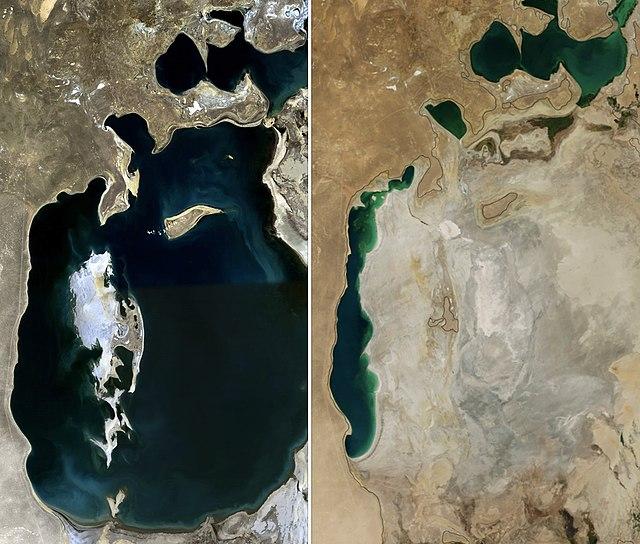 The Aral Sea was once the fourth-largest lake in the world but is now practically gone. This sea is located in Central Asia, between southern Kazakhstan and northern Uzbekistan.
The Aral Sea is actually a saltwater lake, as it has no outlet to the ocean. It was formed by water flowing from various rivers and glacial melt. As one of the largest lakes, the Aral provided water and fish, which were crucial to the region. It supported farming, the fishing industry, and even tourism in the area, attracting people from surrounding regions.
However, the Soviet Union initiated a major water diversion project in the 1960s to irrigate cotton fields. Water from the rivers feeding the Aral Sea had been diverted for irrigation by the Soviet Union since the 1920s, but the 1960s saw the beginning of large-scale redirection. The Aral Sea, once deep blue and teeming with fish, had shrunk to half its original size by the end of the 1960s. The decline continued, and by 1987, the lake split into the Northern Aral Sea in Kazakhstan and the Southern Aral Sea in Uzbekistan.
As the Aral Sea started drying up, it became difficult for the many people who relied on the lake. This also made water more difficult to access, and "Without water, there is no life," said Nafisa Bayniyazova, a farmer who lives close to the Aral.
Now, only a few towns remain due to the uncontrolled dust storms and the lack of water.
Bayniyazova grew up near Muynak, in northwestern Uzbekistan. Like for many farming families, living a farm life was difficult at times, but water from the Aral Sea helped grow crops such as melons, pumpkins, and tomatoes. Bayniyazova’s family persevered through the fall of the Soviet Union and toxic dust storms, but the lack of water in the Aral Sea has made her family’s work much harder.
This once vast and thriving lake is now nearly dried up due to agricultural initiatives and human interference. Not only has this diminished the biodiversity of the region, but it has also led to malnutrition and declining health among local populations.
[Sources: NASA; Associated Press; Atlas of World History]











Loading Comments...