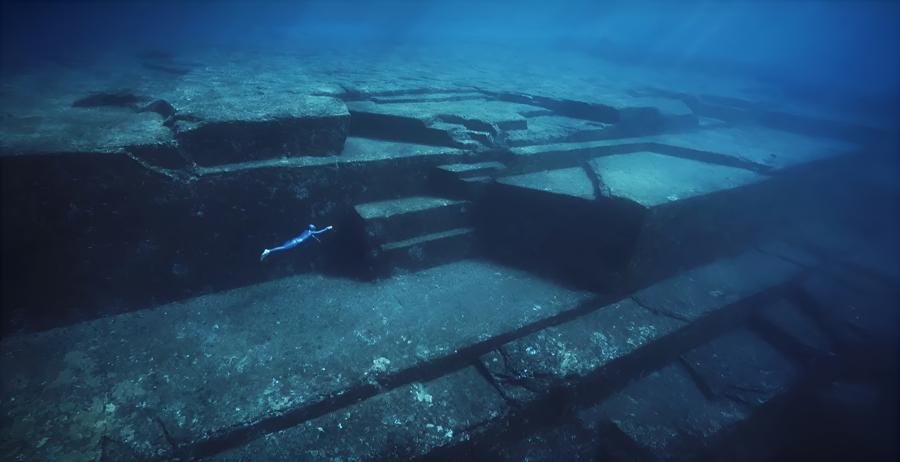
Bizarre Discovery Off Japanese Coast Sparks Fierce Debate
by Mahalia Pearson, age 13
The Yonaguni Monument can be found under the sea, near the island of Yonaguni, Japan. The island is the westernmost part of Japan, so far west that it is only 111 km from the east shore of Taiwan and 2,000 km from Tokyo.
The person who discovered the monument was Kihachiro Aratake. The Yonaguni Monument was discovered in 1986. Before finding the monument, Aratake was already a well-known scuba diver who owned a scuba diving center called Sou Wes, located in Sonai, Japan, on the north shore. While looking for hammerhead sharks, Kihachiro stumbled across a strange structure. He called it “the underwater Machu Picchu.” The site is now called “Kaitei Iseki” (Japanese for “the Monument on the bottom of the sea”). People took an instant interest in the discovery, as its origin is unclear—nobody is sure if it was naturally formed or man-made.
A dive blogger named Florine Quirion wrote about the site. Quirion had learned about the site and wanted to visit it herself. Once she saw it, she was curious about what people thought of the monument, so she made an Instagram post to poll opinions. When the results came in, 67 percent thought the site was naturally made, while the remaining 33 percent thought the site was man-made.
Divers exploring the site say there is sedimentary rock mainly composed of sandstone. Some of this rock forms features that resemble rocky peaks like Tategami rock and Gunkan rock, other famous formations in Japan. Underwater, the monument includes surfaces with rounded or sharp edges. Some divers think that the monument is man-made because of its precisely shaped structures, but others believe these could be the result of natural geological processes like erosion and tectonic shifts.
Winter is not the best time to go scuba diving at the site due to strong winds that make it hard to navigate. However, Quirion went early in the season anyway because she wanted to observe how hammerhead sharks migrated to Yonaguni between January and March. Quirion and her team sketched out a map of Yonaguni. The depth of the monument is relatively shallow; the top part of the terrace is only five meters below the water's surface, and the bottom reaches about 25 meters. Quirion did not dive deeper than 16.1 meters due to the heavy currents. To dive safely to the monument, it is recommended that divers have experience with challenging conditions, including at least 100 logged dives.
There are numerous theories about the monument being man-made or naturally formed. Masaki Kimura, a professor of Marine Geology and Seismology, has studied the Yonaguni Monument for many years, starting in the 1990s, and published multiple articles about it since 2001. He believes the monument is a monolithic structure made of layers of sandstone and mudstone. The monument’s size and appearance are said to have similarities to the Shuri Castle in Naha, Okinawa. A surprising feature of the Yonaguni Monument is its nearly perfect 25-meter-long walls. For such features to form naturally, specific conditions like equal water pressure would be required, but there are differences in the rock. However, many geologists suggest that natural rock formations can create such shapes, making the debate ongoing.
The exact age of the monument remains unclear. Some scientists estimate that it could be as old as 10,000 years, potentially dating back to a time when sea levels were lower. Others suggest that it was formed more recently, around 2,000 to 3,000 years ago.
[Source: World Adventure Divers]











Loading Comments...