The Rise and Fall of Cleopatra, Egypt’s Last Pharaoh
by Estefania Garcia-Fox, age 13
Cleopatra was one of the last rulers of the Ptolemaic dynasty after her father died in 51 BC. She was known to be one of the most famous pharaohs of this period for transitioning Ptolemaic Egypt to Roman Egypt and for holding a great deal of power.
Cleopatra Thea Philopator was born in Alexandria, Egypt, in January 69 BC. She was the second oldest of four. During Cleopatra's early childhood, she was brought up in the palace of Alexandria in Egypt and was well educated. By adulthood, she was well-versed in many languages.
When Cleopatra’s dad died in 51 BC, he passed his throne on to his son Ptolemy XIII and his daughter Cleopatra VII, and they became co-rulers of Egypt. Soon after claiming the throne, they married each other.
In 49 BC, her younger brother drove her out of Egypt and forced her to flee to Syria. While Cleopatra was in Syria, she managed to raise an army. The next year Cleopatra came back to Egypt with her army and fought against her brother and his army at the eastern border. In 47 BC, Cleopatra and Julius Caesar, a Roman military leader and ruler, won the war against her brother and forced Ptolemy to flee the city. Soon after, Ptolemy drowned in the Nile River.
Cleopatra reclaimed the throne in 47 BC with the help of Julius Caesar. To secure the dynasty, she had to marry her even younger brother Ptolemy XIV. Whether it was real affection or not, she also became Julius Caesar's lover. Soon after, Cleopatra had a son with Julius Caesar and named him Ptolemy Caesar, also known as Caesarion or Little Caesar.
In 45 BC, Cleopatra and Caesarion left Alexandria for Rome and were there when Caesar was assassinated. When they returned to Egypt, Ptolemy XIV unexpectedly passed away and Caesarion was made co-regent with his mother.
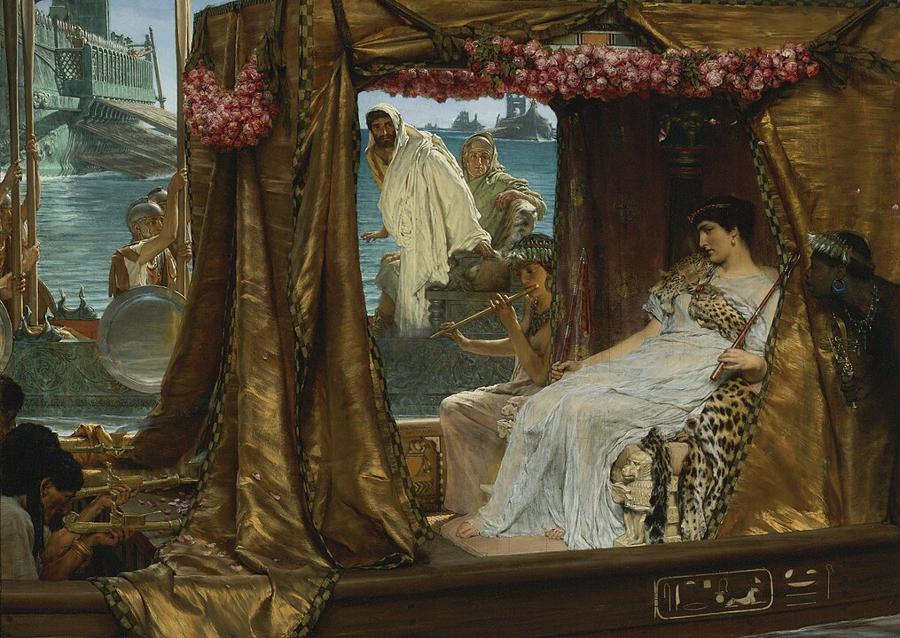
After Caesar’s death, Rome was split between the supporters of leading senators Marc Antony and Octavian. Marc Antony went to Alexandria to establish Cleopatra’s loyalty toward Rome. Marc Antony fell in love with Cleopatra while visiting her.
A few years later in 36 BC, Marc and Cleopatra got married even though Marc had a legal wife back in Rome. This development enraged the Roman senate as Marc had also begun giving away parts of the Empire to Cleopatra and her family.
Cleopatra had twins with Marc, who were recognized by him as his children and were named Alexander Helios (sun) and Cleopatra Selene (moon). Cleopatra’s empire had grown with the help of Marc. Their son Alexander Helios was crowned king of the Seleucid Empire, which included much of the modern-day Middle East, and their daughter Cleopatra Selene became Queen of Cyrenaica and Crete.
Later on, Cleopatra had another kid with Marc Antony, Ptolemy Philadelphos, who was named King of Syria and Asia Minor – modern-day Turkey – at the age of two years old.
In 32 to 31 BC, Marc Antony divorced his Roman wife, Octavia, forcing the wider world and Rome to recognize his relationship with Cleopatra. When Marc added Cleopatra’s name to the Roman coinage, he effectively ended his allegiance to Rome.
Back in Rome, Octavian declared war against Egypt. The Egyptians were defeated off the coast of Greece during the famous battle of Actium in 31 BC. Arriving a year later, in Alexandria, Octavian defeated Marc Antony. Marc had fallen on his sword and died in Cleopatra's arms. He was buried as a king.
Octavian wanted to bring Cleopatra back to Rome to be kept as a prisoner in his triumph, but Cleopatra ended up taking her own life to avoid this humiliation. Cleopatra’s relationships with powerful leaders such as Julius Caesar and Mark Antony not only shaped her reign but had lasting impacts on Egypt and Rome. Despite her tragic end, Cleopatra’s legacy is a symbol of strength and ambition.
[Source: Women Who Changed the World]











Loading Comments...