Colugos: Incredible Gliders That Soar Through Southeast Asia
by Delany Onyango, age 9
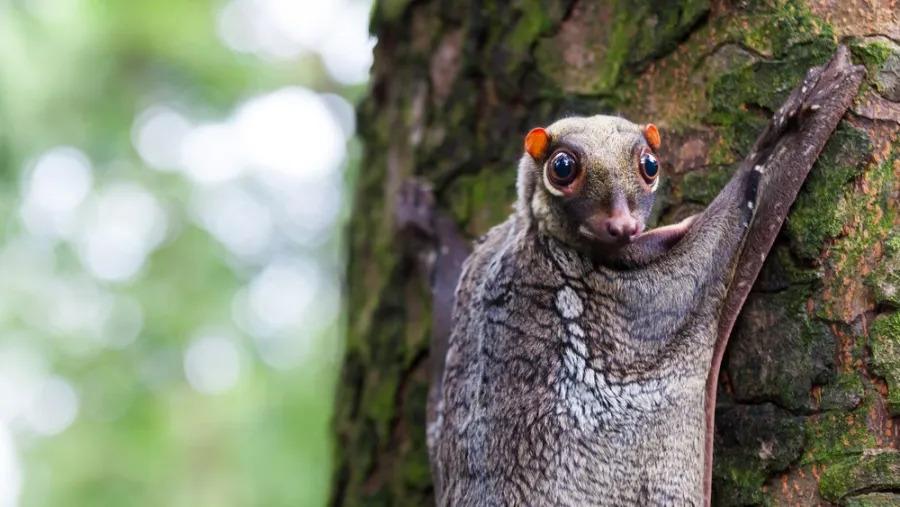
Although the colugo, a creature that resembles a flying chipmunk, cannot fly, it has the remarkable ability to glide through the air. The colugo has a patagium, which is the stretchy skin that connects its limbs, allowing it to glide between trees.
When fully extended, their patagium can span up to 28 inches, helping them glide distances of up to 328 feet. The colugo can fold up its patagium to avoid getting caught in twigs or other sharp objects and uses its tail to steer while gliding.
In addition to its patagium, the colugo has other interesting physical features. These creatures are relatively small, only weighing around two to three pounds and growing up to a length of 17 inches. The colugo’s feet, equipped with sharp claws, allow it to cling to tree trunks. Colugos have specialized pectinate teeth with up to 20 comb-like slits, which they use for grooming their fur and straining food. Their fur has various spotted patterns that provide excellent camouflage in their forest environments.
The colugo shares some traits with the bat family, especially with species like the Indian flying fox. Both have large eyes that are useful for nocturnal navigation. Along with its excellent night vision, the colugo has protruding eye socket rims that help protect its eyes during gliding.
There are two species of colugos: the Malayan colugo, found across Southeast Asia and several Indonesian islands, and the Philippine colugo, which resides in the Philippines. While their exact mating season is uncertain, it is believed that colugos can reproduce year-round, typically giving birth to one offspring each year.
The colugo is a fascinating animal that can glide over 328 feet in a controlled flight! Although they resemble flying squirrels, colugos have their unique evolutionary path and belong to a different group of gliding mammals. These adaptations make them an intriguing part of the natural world.
[Source: The Encyclopedia of Animals]











Loading Comments...