Why Mysterious Giants Live in the Deepest Oceans
by Samuel Garduño Martínez, age 17
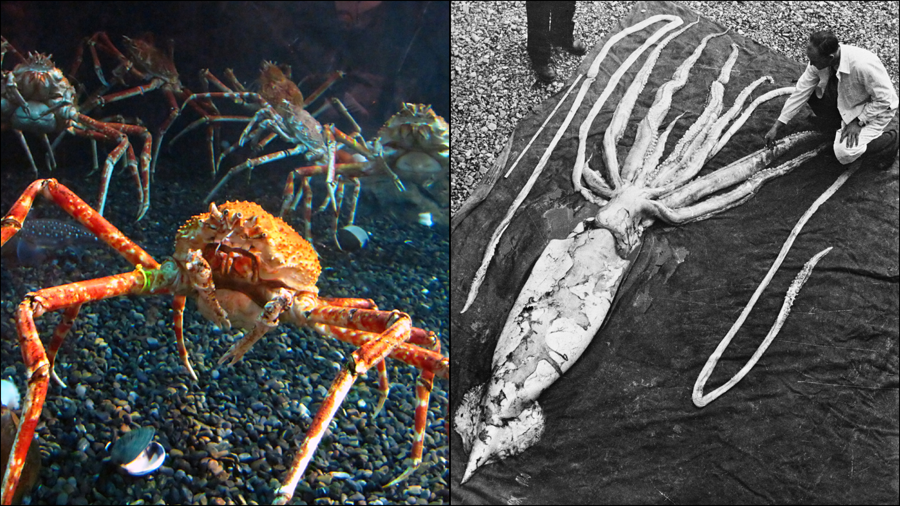
When comparing spider crabs on shore to those on the ocean floor, the 13-foot-wide ocean crabs put the meager shore crabs to shame. This trend of going deeper and getting bigger seems common in nature, prompting the creation of the famous adage, “the deeper they go, the bigger they get.” There is scientific data to support this assertion, however, terrestrial animals have also been known to grow to huge sizes. Although aquatic animals aren’t the only ones who have benefited from their larger sizes, gigantism has been a key factor in the survival of creatures in the mighty oceans.
Due to the lack of food at the bottom of the ocean, resourcefulness has played a part in animals’ huge sizes. Larger organisms need less energy per mass than smaller creatures—in other words, they are more energy efficient. Kleiber’s law, a mathematical model, supports this train of thought, equating larger organisms with less food needed per unit of body mass. This is why cats, despite being one hundred times heavier than a mouse, will only need thirty times more calories. In the depths of the dark and cold sea, the ability to get the most out of sparse food, usually found as bits of debris, is essential to survival. Some animals have developed unique characteristics, such as gaping maws or extendable stomachs, to best prepare for their unanticipated mealtimes. Although Kleiber’s law has a good mathematical basis, the energy-to-mass ratio doesn’t show the entire picture. It fails to recognize other environmental and evolutionary factors contributing to such adaptations.
The exact mechanisms behind size and energy conservation are not clear, however, they could be attributed to temperature. Generally, larger creatures will retain more heat because of their size, comparatively losing less heat per unit of body mass. Additionally, their size allows them to conserve more heat from metabolism.
Extra mass is especially convenient in colder environments, such as Antarctica and the deeper portions of the ocean. For example, warm-water penguins are much shorter and lighter than emperor penguins, their Antarctic counterparts. The same also holds true for the giant squid, which can grow up to 40 feet.
Surprisingly, living in lower temperatures also serves as an advantage to bigger creatures. Cold-blooded animals in cold ocean waters experience less “wear and tear” over time as a result of slower-functioning cells. Temperature is one of many elements that may have contributed to gigantism, but it isn’t the only one.
Food is another environmental factor that will drive creatures to grow to enormous sizes, perfectly exemplified by whales’ change in size. For instance, whales were not always the behemoths we know them to be. Up until five million years ago, whales peaked at 20 feet long. Whale growth truly took place when the planet cooled and glaciated. Colder water contains higher levels of oxygen and encourages the upwelling of nutrient-rich water. This led to the growth of phytoplankton —the blue whale's favorite food. However, the seasonal availability of such prey required whales to travel farther to capture them. Consequently, whales evolved to thrive in their habitats. In order to hunt, whales have to travel long distances. To do so, they’ve adapted to store body fat, which also makes them large. Being larger also helps them move through the oceans more easily.
Although larger animals have their own struggles, such as an increased amount of food, gigantism has been a key element to their domination of the animal kingdom, but especially in the vast and bottomless ocean.
[Sources: Discover; The New York Times; Popular Mechanics]











Loading Comments...