Black Holes Are Mysterious Giants That Shape Our Galaxy
by Aloniab Gezae, age 10
A black hole is a region in space with an extremely powerful gravitational force. Black holes aren’t holes; rather, they are composed of extremely dense material packed into a tiny space, creating a remarkable force that pulls everything inward. This gravity draws in anything that comes near, and it is so strong that even light cannot escape. Black holes are called “black” because they are invisible in space.
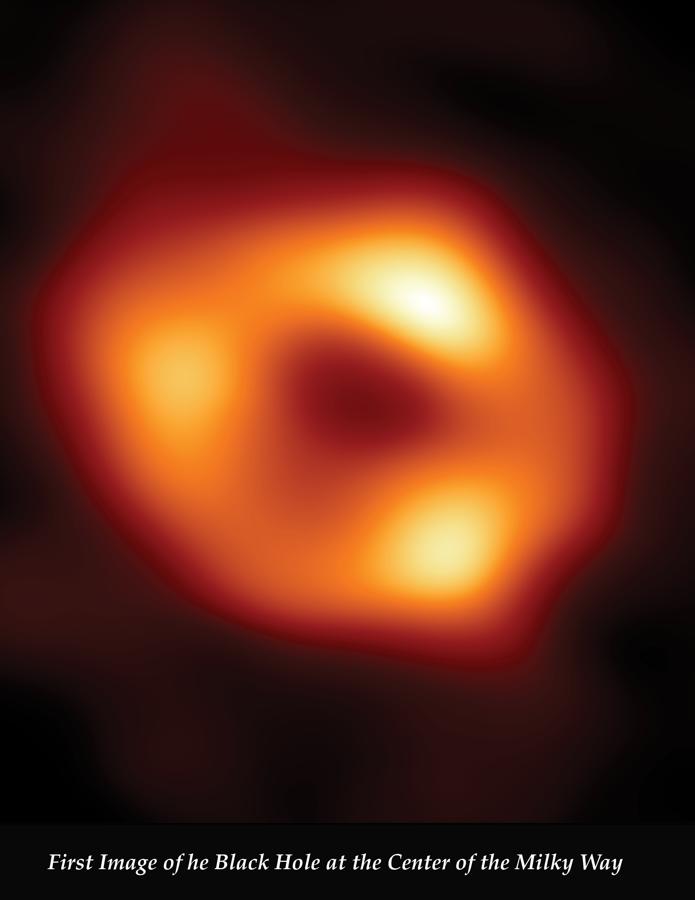
There are two types of black holes, a supermassive and a stellar. Supermassive black holes are the largest, with masses millions of times greater than that of the sun. The black hole at the center of our galaxy, known as Sagittarius A, is a supermassive black hole that plays a crucial role in influencing the motion of stars around the center of the Milky Way. The most common type of black hole is the stellar black hole, which forms from the collapse of a massive star and can be around 20 times the mass of the sun.
A black hole is made from an exploded star. A star is a gigantic sphere of hydrogen, which powers it through nuclear fusion. When the star runs out of fuel, it collapses, triggering a supernova. A supernova is an explosion caused by the star’s core collapsing under gravity. After the explosion, if the core's mass is high enough, a black hole is left behind. Many large galaxies have supermassive black holes at their centers, but not every galaxy necessarily has one.
As you approach a black hole, time seems slower for those farther away, a phenomenon known as gravitational time dilation. Theoretically, this means that time would pass more slowly near the event horizon of a black hole, allowing those closer to experience time differently than those far away. However, using black holes as time machines is not practical for humans due to the extreme conditions near them.
Humans cannot directly see black holes, but as material enters a black hole, it heats up and emits X-rays. Scientists can detect these X-rays using special telescopes, allowing them to study black holes indirectly.
Black holes are mysterious, fascinating, and crucial to understanding space; however, we know very little about them. Despite being invisible and challenging to study, black holes play a major role in shaping the dynamics of galaxies, and they continue to be a focus of scientific research, providing insights into the wonders of the universe light-years away.
[Sources: National Geographic Society; Encyclopedia Britannica]











Loading Comments...