Nebulae Are the Birthplace of Stars
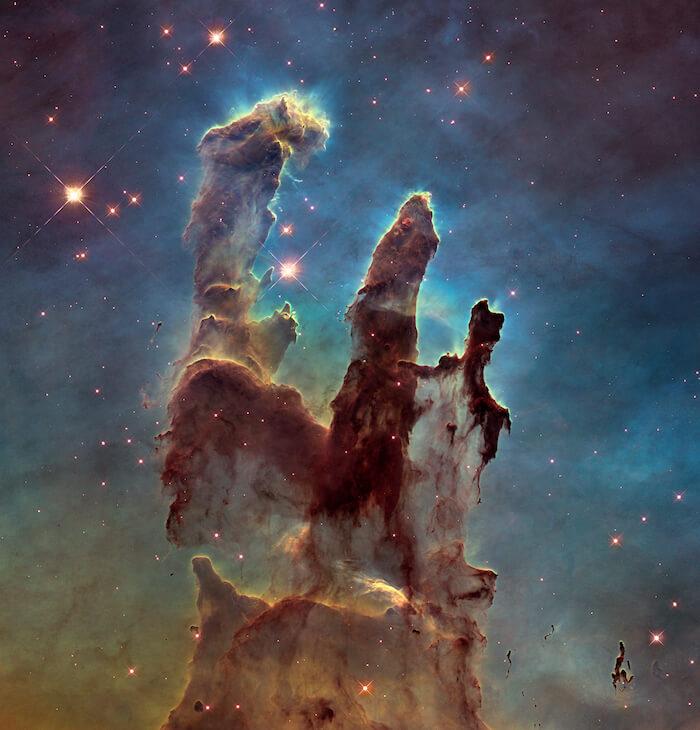
by Malak Alquraishi, age 13
A nebula is a giant cloud of dust and gas. There are several different types of nebulae, and they are an essential part of the interstellar medium—the matter that exists in the space between stars within galaxies. Nebulae are among the most spectacular sights in astronomy.
In Latin, "nebula" means cloud, but in an astronomical context, it describes any celestial object that appears cloud-like when viewed through a telescope. With the benefit of modern telescopes, scientists now know that galaxies once thought to be nebulae, are composed of billions of stars. As a result, astronomers now reserve the word "nebula" for genuine clouds of gas and dust, which can be found throughout our galaxy and beyond.
Most nebulae are made of gas that glows with its light, creating colorful displays. This glowing effect is often due to ionized gas, such as hydrogen, being energized by nearby stars. Other nebulae, such as dark nebulae, are composed of more dust. Instead of glowing, they block light from more distant objects, creating dark patches in the sky. Reflection nebulae do not emit their light but instead reflect the light of nearby stars.
Nebulae play a key role in a star's life, from birth to death. Stars are born in dense regions of gas within nebulae, often referred to as stellar nurseries. Gravity causes clumps inside a nebula to collapse into stars. At the end of a star's life, if it is similar in size to our Sun, it may shrink into a white dwarf and release gas and dust to form a new nebula. Massive stars, on the other hand, can explode in supernovae, sometimes leaving behind neutron stars or black holes, while also contributing to the formation of new nebulae.
Nebulae, the colorful clouds of gas scattered across the universe, are cosmic nurseries and fundamental to our understanding of the life cycles of stars. They play a key role in shaping galaxies and allow us to observe the dazzling lights in the night sky.
[Source: Space]











Loading Comments...