Exploring the Moon’s Formation and the Arrival of a Temporary "Second Moon"
by Semaia Zerezghi, age 9
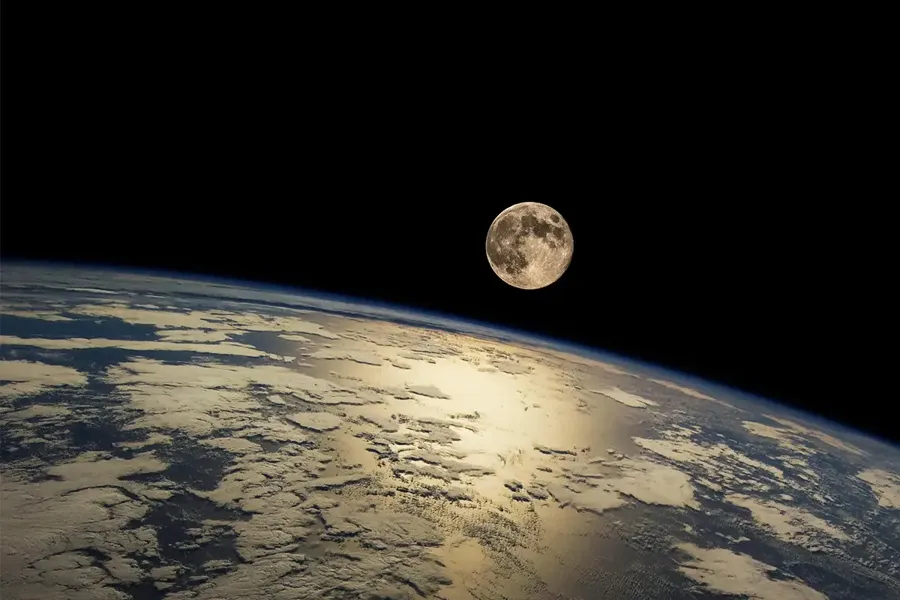
The Moon was formed at the same time as Earth when a large object, roughly the size of Mars, collided with our planet. The debris from this colossal impact collected to form the Moon, and Earth's gravitational force kept it in orbit. As a result of this crash, the Moon and Earth share many similar materials, although they are not identical.
No other moon is as large relative to its parent planet as Earth's Moon. To understand their relative size, imagine Earth as a basketball and the Moon as a tennis ball 24 feet away. Using this comparison, the Sun would be the size of a large house almost two miles away. The Moon's outer layer is covered in powdery soil, craters, dead volcanoes, and wide lava plains. Unlike Earth, the Moon has no atmosphere, causing its surface temperatures to drop to around -280 degrees Fahrenheit at night and rise to about 260 degrees Fahrenheit during the day.
The Moon goes through changes called "lunar phases." During the first phase, the new moon, no light is reflected. After that, the phases progress through the waxing crescent, first quarter, waxing gibbous, full moon, waning gibbous, last quarter, and waning crescent. These phases repeat in a cycle that lasts about 29.5 days.
The Moon takes the same amount of time to spin on its axis as it does to complete a single orbit around the Earth—about 27 days. This phenomenon, known as tidal locking, is why we always see the same side of the Moon.
Starting late Sept. of 2024, the Moon will be joined by a second moon. From Sept. 29 until Nov. 25, astronomers calculate that an asteroid, a “mini-moon, " will be orbiting Earth temporarily. Though its small size, about 10 meters, will make it nearly impossible to see, this mini-moon will briefly join Earth's orbit before breaking free and returning to space. Scientists believe this asteroid could be a fragment from the Moon itself, possibly ejected from a lunar impact. While this phenomenon is rare, Earth occasionally captures objects from the Near-Earth Object (NEO) population, pulling them into temporary orbits before they escape again.
The Moon, formed from a colossal collision in the early days of our solar system, offers us a unique window into understanding space. Scientists continue to develop new insights and methods to explore and understand our universe by studying its composition and history.
[Source: Planetarium; Times Magazine]











Loading Comments...