The Largest Moth in the World Inhabits Tropical Rainforests
by Bridgett Park, age 12
The atlas moth, also known as Attacus atlas in scientific terms, is a moth found in Southeast Asia and is the largest moth in the world. They are found in tropical rainforests of Asia, having only two seasons—dry and wet, so these moths don’t have to migrate to other places, and these tropical rainforests have consistent, warm weather. The countries where atlas moths can be found include: India, China, Vietnam, Taiwan, Indonesia, Brunei, the Philippines, and Papua New Guinea.
Like many other insects, like praying mantis and love bugs, female atlas moths are bigger than males. The adult female’s body length is 39 to 40 mm, while the adult male’s is 30 to 36 mm. The wingspan is 240 mm-250 mm for females, while it is 210 mm-230 mm for males. The adult mouthparts are usually absent and non-functioning.
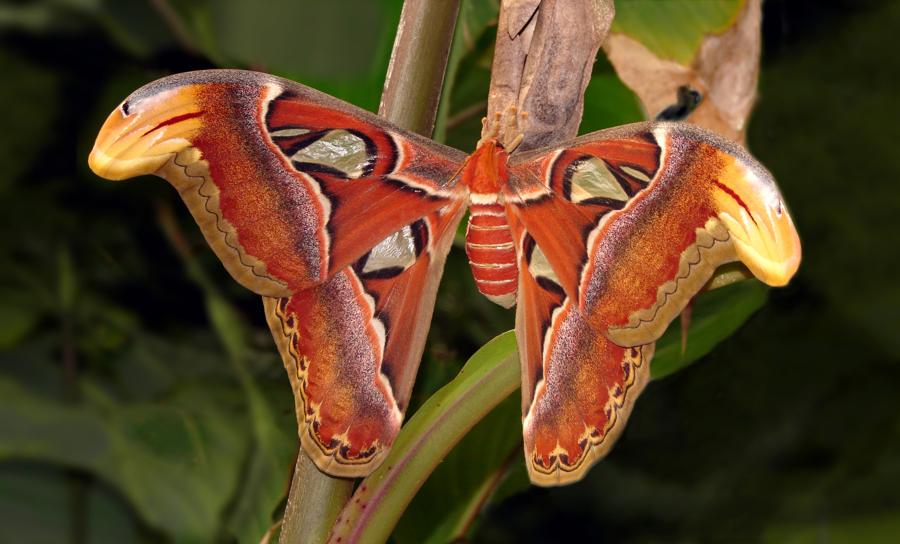
These moths have rounded vibrant wings. The base of their wing is deep orange, soft brown, or a reddish brown patterned with colors of white, black, and pink. A large white hyaline (glassy) spot is at the center of each wing. The edges of the upper wing resemble the head of a snake.
Atlas moth eggs are yellowish white and have an oval shape. They are covered in a substance on leaves. They can occupy habitats at elevations from sea level up to 2000 meters. The larvae are pale green with brown spots and a white substance on the upper side of the larval body. In the pupal stage, it is surrounded by a brown cocoon. The cocoons can vary in size, shape, and shade.
Atlas moths have four main life stages: the egg, larval, pupal, and adult. The fertilized eggs are laid on a host plant by the female moth and hatch one to two weeks later. There are 134 to 160 eggs per season, and females only breed once in their lifetimes. Males, however, can mate multiple times depending on how long it takes to find a female. Atlas moths only breed during the week they live as adults. Parent atlas moths do not raise their offspring; rather they just leave. Their only predators are a few mammals and birds.
These moths are enormous, and some have been reported as pests; even a few caterpillars might have a negative impact on trees. However, on the positive side, they have been popular in the pet trade due to their docile activity levels and are not harmful to humans.
From their interesting life cycle to their colorful and captivating features, the Atlas moth is a beautiful insect. If you ever have the chance to visit its habitat, see if you can spot one!
[Source: animaldiversity.org]











Loading Comments...