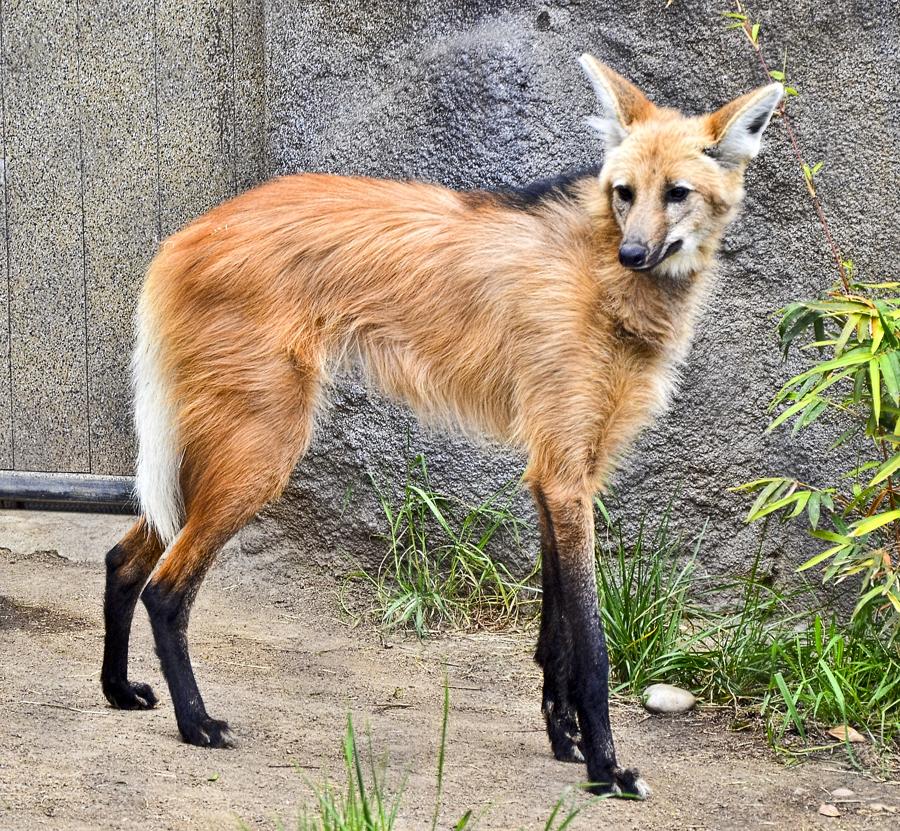
It's Not a Fox! It's a Maned Wolf!
by Lucas Abiy, age 9
The maned wolf looks similar to a fox; however, it is not part of the fox family. The maned wolf has reddish orange colored fur, long black legs, and tall upright ears. It is one of the largest canids of South America.
The maned wolf can be found in dry forests, grasslands, savannas, marshes and wetlands across South America. Their range includes Argentina, south and central Brazil, Paraguay, Bolivia, and southern Peru. The maned wolf lives up to 6.5 years in human years and 15 years in dog years. This species marks its territory with its powerful scent of urine, mostly urinating on termite mounds around its territory.
Maned wolves are omnivores and solitary hunters, although they sometimes eat abandoned fruit and vegetables, they are mostly interested in lobiria, a small tomato. These animals don’t howl, instead, they will make loud barks or sometimes a roar. Loud barks help them signal to potential mates.
Maned wolves are skilled hunters. Their ears have the ability to rotate, creating an advantage in hunting. These wolves will lightly tap the ground to flush out their prey before pouncing on them when they surface. The maned wolf also has a high vertical jump, giving it the ability to catch birds and other insects that are mid flight.
The maned wolf lives around many larger predators such as crab eating fox, hoarty fox, pampas fox, but only the puma and domestic dogs have been reported to kill the maned wolf. Their population has been left nearly threatened at approximately 17,000. Scientists have figured out that the average number of pups produced is 2.5 per mother. Scientists have also found that female wolves are responsible for taking care of their pups. Males provide food for their pups in the zoo and the wild. The pups nurse for about four to five weeks, and leave their parents territory at about one year old.
Maned wolves are unique fascinating creatures, they are sometime misunderstood but are still cool animals. Their skilled hunting abilities allow them to survive and thrive in the wild.
[Sources: Encyclopedia of Animals; San Diego Zoo]











Loading Comments...