'Tomato Frogs' May Look Cute, but Predators Beware!
by Andrea T., grade 6
Tomato frogs are adaptable to many environments. Even though tomato frogs can adapt to different environments, they still face threats. Habitat loss and pollution are concerns for their survival. On the endangered species list, they are listed as “Near Threatened." For people to help, they need to learn about tomato frogs.
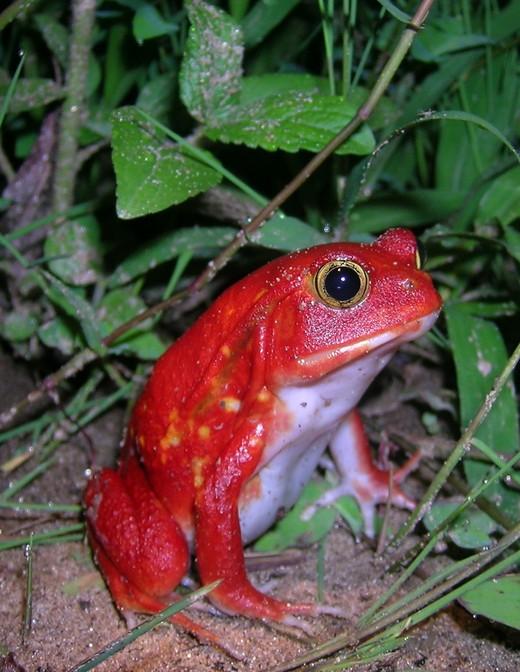
Male and female tomato frogs are different in a few ways. Males are around 6 to 6.5 cm long and appear more brown than red. Female tomato frogs can grow to be 10.5 cm long and have the bright red color that they get their name from. Young tomato frogs are born with a tan or black color that turns into a brownish-red as they grow. The color change happens in just a few months.
These frogs are found only in Madagascar and are seen throughout the country. The majority of tomato frogs live in the northeastern part of the island, in places like Antongil Bay, Andivoranto, and Maroantsetra. Tomato frogs can survive in many environments, such as rainforests, coastal woods, wetlands, and even urban areas, including drainage ditches near villages. If there is soft ground to burrow into and slow-moving or still water nearby, tomato frogs can survive in them too.
The lifecycle of a tomato frog is nearly the same as that of other frogs. Males call out to attract females, especially during wet conditions. Once the frogs mate, the female can lay eggs, and sometimes up to a thousand, in slow-moving or still water such as ponds or pools. The eggs hatch in a few days, and tadpoles begin to develop. After one to two months, they become young frogs, and after two to three years, they become fully fledged adults. One difference in the tomato frog's lifecycle from that of other frogs and animals is that tomato frogs do not care for their young after the eggs are laid.
Tomato frogs spend a lot of their time hiding. They like to burrow in soft soil, leaves, or mud during the day. At night, they move around to find food and are a lot more active. They are not strong swimmers, so they prefer shallow water. Tomato frogs ambush predators by waiting quietly, so the prey comes closer before they attack. They have some interesting defense skills. Their bright color warns predators that they are not easy to eat. When tomato frogs are threatened, they release a thick, white, glue-like substance from their skin. This sticky substance can irritate predators and make it hard to move or see. They can also puff up their body and make themselves look hard to swallow.
Tomato frogs are critical to the ecosystem because they consume small animals and insects. When in the wild, they eat almost anything small enough to catch. Their larvae, or tadpoles, may feed by filtering tiny particles from the water. Tomato frogs use their tongues to catch prey, and like other frogs, they rely on good aim and quick movements.
Tomato frogs play an important role in the ecosystem. Their ability to survive in both human-made environments and nature shows how adaptable they are. With their unique defenses, bright colors, and interesting life cycle, tomato frogs truly are among Madagascar's most fascinating amphibians. Now that people know about tomato frogs, they can take steps to help save them.
[Sources: Smithsonian's National Zoo & Conservation Biology Institute; The Dallas World Aquarium; Animal Diversity Web]











Loading Comments...