How the Mayans and Aztecs Imagined the Birth of the World
by John Agbo, age 14
The Aztecs and Mayans shared numerous mythological figures. For instance, both cultures worshipped a feathered serpent as a central mediator between the heavens and the earth. The Mayans recognized Kukulkan as the god of cycles, encompassing life and death, while the Aztecs viewed Quetzalcoatl as a cosmic entity who ruled over the sun during one of the five eras, or “suns,” in their creation story.
Kukulkan played a vital role in Mayan mythology. He was revered as a god of rain, wind, and storms, symbolizing renewal, like a snake shedding its skin. For the Mayans, time was cyclical and occurred in intervals known as Baktuns, signifying one of the most important concepts in their culture. Kukulkan embodies the eternal cycle of death and rebirth. Priests and kings often claimed descent from this god to reinforce their power.
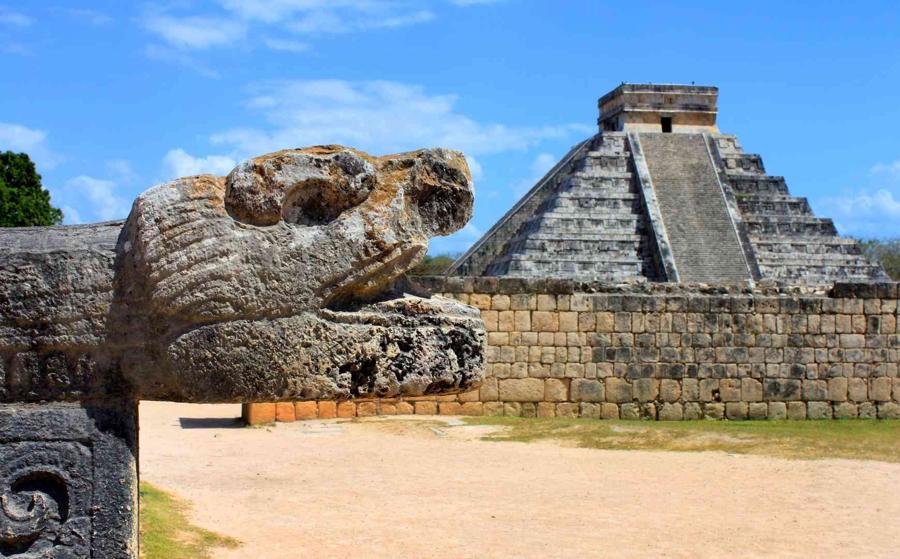
The Mayans built temples throughout Mesoamerica, with one at Chichen Itza honoring Kukulkan. This temple stands as a testament to the Mayans’ understanding of astronomy, architecture, and mathematics. The Temple of Kukulkan aligns with the sun’s movements, creating a spectacular event during the spring and fall equinoxes. When the sun hits the pyramid at just the right angle, it casts a shadow down the northern stairway, resembling a serpent slithering down to the base.
In Aztec mythology, the feathered serpent Quetzalcoatl served a similar role as a bridge between the heavens and the earth. Known as the bringer of civilization, he introduced knowledge, language, and agriculture to humanity and was associated with wisdom, order, and the cosmos. He played a more explicitly creative role in mythology than Kukulkan. Although the Aztecs did perform human sacrifices, Quetzalcoatl was known for opposing this practice, and there were fewer sacrificial rituals associated with him compared to other Aztec gods like Huitzilopochtli.
In creation stories, both Kukulkan and Quetzalcoatl were central figures. In Aztec myth, Quetzalcoatl was one of the four sons of the dual creator god Ometeotl (Ometecuhtli and Omecihuatl). Alongside his brother Tezcatlipoca, he helped create the cosmos by defeating the primordial sea monster Cipactli, whose body became the earth. Later, he created humans by retrieving bones from the underworld. After falling into a pit and breaking some of the bones, he mixed them with his blood, giving rise to imperfect humans of different sizes and lifespans.
In Mayan creation myths found in the Popol Vuh, the void gave rise to the sky and sea, where gods recognized the potential of emptiness. Kukulkan, the “Plumed Serpent,” and Huracán, the “Heart of the Sky,” united to create the world through the power of speech. They first formed mountains and plants, but the silence compelled them to create animals. Dissatisfied with animals' inability to speak, they attempted to create humans from mud and then wood. When these beings failed to praise their creators, the gods destroyed them in a great flood. It is said monkeys are the descendants of the wooden people.
Finally, the gods created the maize people, who were made from corn dough. These beings were intelligent and emotionally aware. However, fearing they were too perfect, the gods limited their sight and knowledge. These first humans climbed a sacred mountain to honor their creators and witnessed the first sunrise.
Mayan and Aztec mythologies are similar to those between the Greek and Roman pantheons, feathered serpent gods with different names, attributes, and regional interpretations. Although the Mayan and Aztec civilizations have faded, their beliefs and stories remain strong. People can disappear, but their ideas endure.
[Sources: Mythopedia; ChichenItza Wonder of the World; National Museum of the American Indian; University of Texas at Austin; Yale-New Haven Teachers Institute]











Loading Comments...