Must-See Japanese Print Exhibition at MMoCA Museum on State Street
by Ayelen Flores Ruiz, age 15
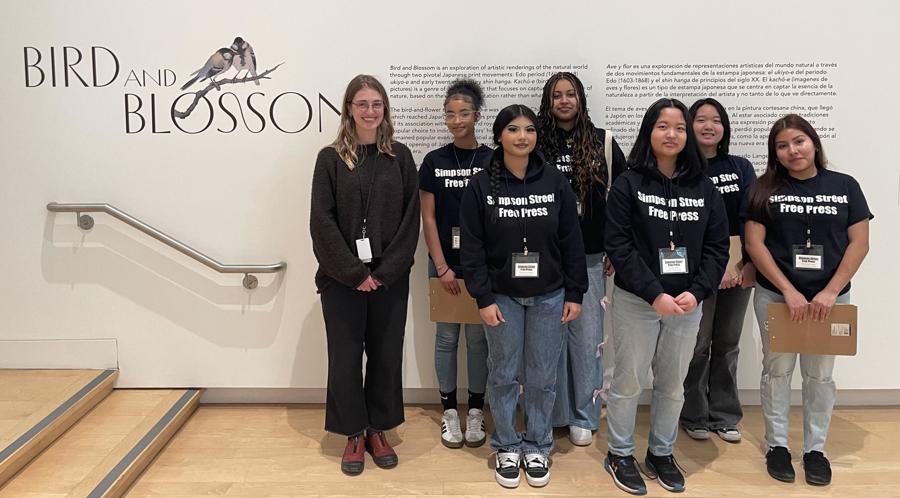
Simpson Street Free Press recently visited the Madison Museum of Contemporary Art’s exhibit titled “Bird and Blossom,” featuring Japanese woodblock prints from the museum’s permanent collection. We were greeted by Eleanor Pschirrer-West, MMoCA’s assistant curator, who explained the significance of and history of the exhibit.
MMoCA is currently showing 19 prints made in the Japanese kachō-e style, which translates to “flower and bird pictures.”
These prints were created during two Japanese artistic movements: the ukiyo-e movement from the Edo and Meiji periods, and the shin-hanga movement from the twentieth century. Between the two movements, there was an influx of western art available in Japan, and its influence can be seen in the differences of perspective and depth in the prints from the two periods. They were all made using a technique called woodblock printing.
Pschirrer-West explained the process of making a woodblock print. First, the artist would sketch or draw the image on paper, which would effectively become a blueprint for the carver. The carver would then carve away the areas of the wooden block, leaving ridges that would be rolled with ink, “sort of like making a stamp.”
A sheet of paper would then be pressed onto the block. This process is repeated for the different layers of detail for the image, using different blocks for each layer, until they are all printed onto each other to create the final piece of art.
All of the displayed prints are part of the museum’s permanent collection, which began in 1968. Rudolph and Louise Langer, who moved to Madison in 1927, supported the Madison Art Association, which later became the Madison Museum of Contemporary Art. Their collection of over 1,000 artworks were left to MMoCA in the Langer will in 1968.
Pschirrer-West and MMoCA staff demonstrate a real passion about this show. The care and thoughtfulness involved in exhibiting this part of the museum collection is clear for viewers to see. These prints are very delicate, since some of them date back several hundred years.
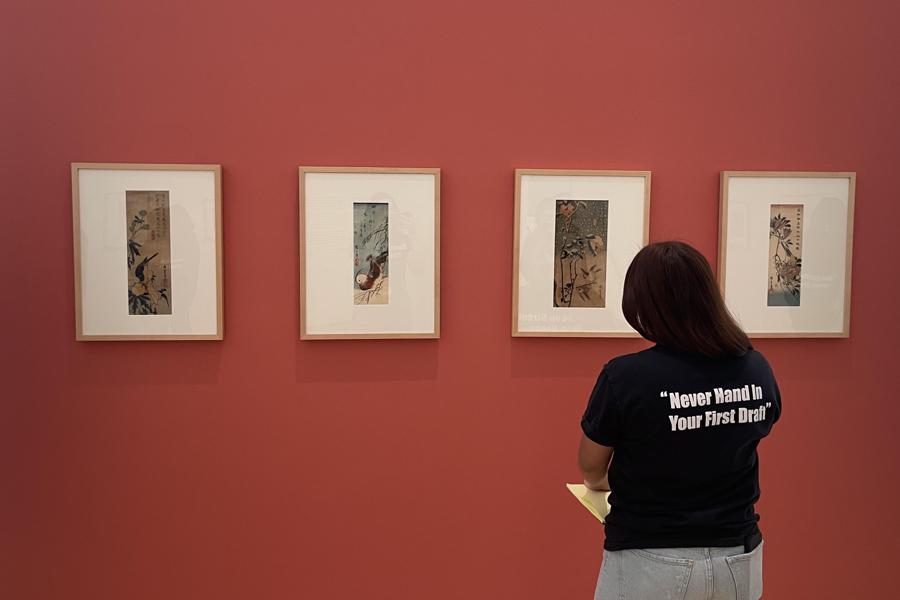
One factor Pschirrer-West mentioned to us was deciding how to position the prints in the gallery. For example, four of the oldest prints, made by Utagawa Hiroshige during the Edo period, were placed on a red wall facing away from the gallery’s window, to minimize the amount of light absorbed by the paper.
The exhibition was beautifully laid out and eye-catching. Two prints that stood out for us were the “Blue Robin on a Maple Branch” and the “Bull-Headed Shrike Looking at a Spider” because of the color gradients in the background of the prints. Both were made by artist Ohara Koson, who specialized in kachō-e prints during the shin-hanga period. He lived through shifts in society–like industrialization and centralized government–during the Meiji Restoration in Japan.
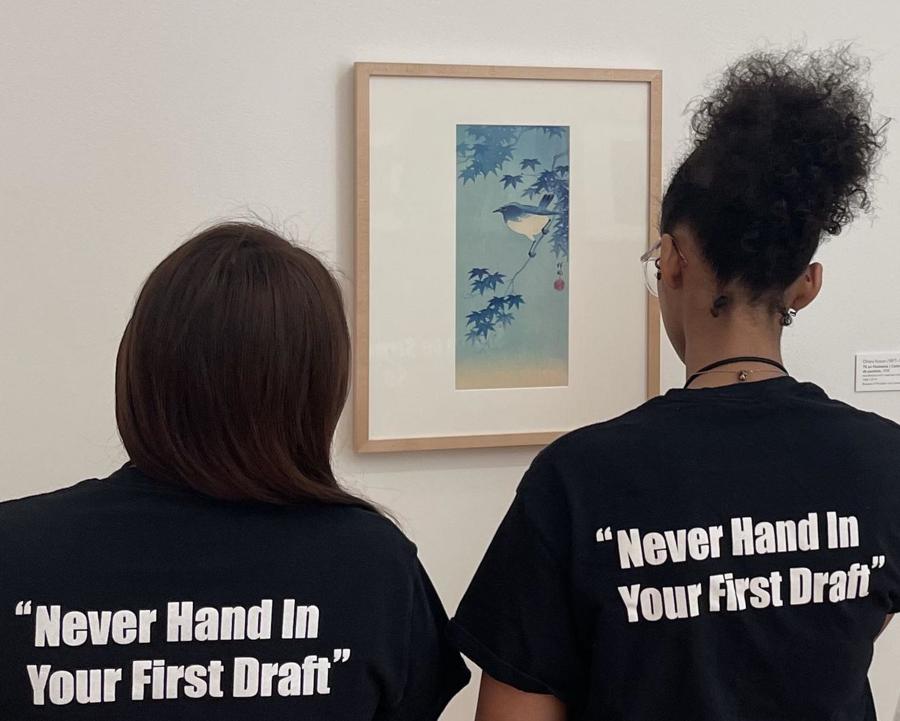 The “Blue Robin on a Maple Branch” is a print in all different shades of blue. The robin looks calm, enjoying the view from the maple branch. Up close, one can see the individual marks from the carved-out woodblock, which showcases the level of intricacy and detail of this medium. The image has a gradient of blue, from light to dark.
Similarly, the “Bull-Headed Shrike Looking at a Spider” also displays a technique called bokashi, which was used to create the light-to-dark gradient.
Pschirrer-West described several ways to accomplish this technique, such as carving the woodblock with a slope, so areas higher on the slope would transfer more ink to the paper, or by wiping some ink off the block before pressing the paper on top. In the image, the multicolored bird eyes a spider in the center of its web. The web itself was made with extremely delicate lines, some of which seem brighter and resemble the way light reflects off a spider’s web in real life.
All 19 prints show the “essential relationships” between the living creatures of the Earth, Pschirrer-West pointed out. The prints depict vignettes of a bird and a plant, or a bird and an insect, and how they interact with each other. The limited opportunity for the carver to include background details allows the viewer to focus on what’s in the foreground without the other distractions that one would normally experience in nature. It provides the viewer with an almost meditative experience.
There are two events coming up for interested visitors. The first event will be “An Indoor Nature Walk of Bird and Blossom” on March 8th, featuring a gallery tour led by UW Madison professor and wildlife specialist David Drake, who will delve into the habitats shown in the various prints. The second event will be a “Curator Talk” on March 14, providing visitors the chance for a guided tour with Eleanor Pschirrer-West.
The free exhibition will be open to the public until April 6th at the Madison Museum of Contemporary Art, located at 227 State Street, next to the Overture Center for the Arts.
[Sources: Isthmus; Madison Museum of Contemporary Art]











Loading Comments...