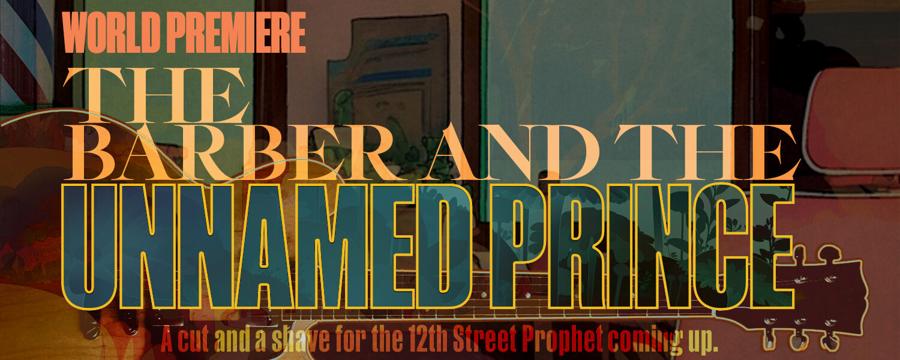
American Players Theater Review: "The Barber and The Unnamed Prince"
by Jules Da Costa, age 17
The world premiere of Gavin Dillon Lawrence’s “The Barber and The Unnamed Prince,” now playing at American Players Theater until September 25th, is more than a tribute to the “Chocolate City.” It’s a reflection of identity, fatherhood, and the erasure of culture in a city changing too fast for its people to hold on.
Originally titled “The Death of Chuck Brown,” the DC music icon and Godfather of Go-Go was a prominent theme in the play. However, the play’s title and content were recently slightly changed after the Brown family expressed their opposition to Chuck Brown’s name and music being used. The main plot of the play remains unaltered.
Entirely set in a barbershop, the play follows Kofi, a middle-aged barber deeply rooted in tradition, and his struggle as a Black man in America as he wrestles with raising his teenage son, Prince. The play opens to a stage filled with smoke and the spirit of the Ancestor, played by La Shawn Banks, moving in a slow, flowy motion. The scene quickly cuts to the barbershop, where Kofi, played by David Alan Anderson, and childhood best friend Sweep, portrayed by Nathan Barlow, are opening up the shop and reflecting on their glory days. The changing atmosphere in and around the barbershop seems to be a prominent symbol of a community at risk of being forgotten.
The brotherly love between Kofi and Sweep is showcased throughout the play despite the two not being directly related through blood. Anderson and Barlow show this love convincingly through their physicality and expressions, as well as their lines. Through their characters’ relationship, the play explores different types of families. As playwright, director, and APT core company member Gavin Dillon Lawrence said in a pre-show play talk, “In this play, we have chosen family and biological family.”
Sweep is a recovering addict who is employed by Kofi and receives relentless reprimands from him at the beginning of the play. Yet Kofi’s tough love stems from deep care. Throughout the story, it becomes clear that Kofi acts as a father figure not only to his son Prince, brought to life by Jonathan Gardner in his mesmerizing stage debut, but to Sweep and other characters in the play as well. Kofi is the emotional backbone of the community and to all who come into his shop, offering support and wisdom to those around him.
Kofi is a committed father and successful businessman, which allows him to defy the stereotypes often projected onto Black men. He is deeply respected within his community, but through Anderson’s stoic performance, we see how heavily the effects of gentrification weigh on Kofi. The barbershop was once a place of connection and culture for him, which we see echoed by the few longtime customers who enter the shop throughout the play.
The changing neighborhood is showcased even more clearly when Ricky, a white history teacher at the local high school, played by Josh Krause, enters the barbershop for a haircut. Kofi and Sweep are taken aback, not out of hostility, but because they run a Black barbershop that usually cuts Black hair. However, Ricky's nuanced character challenges the others’ views about white people. Krause captured the subtleties of Ricky’s character, who himself defies stereotypes of white men. He attended an HBCU, possesses vast knowledge of Black history, and even joins in on a spontaneous dance party where he shows off the groovy moves he picked up in college. Krause’s compelling portrayal of Ricky forces the audience and the other characters to see that social change is prominent in more ways than one.
A similar complexity is seen with the characters Sparkle and Smitty. Sparkle, the mother of Prince’s girlfriend, played by Shariba Rivers, embraces the shifting neighborhood, adapting to survive and thrive in the new environment. She acknowledges that with change comes new opportunities. In her conversation with Kofi at the barbershop, she explains her approach: when your surroundings change, you can change with them or you can leave, but it’s happening with or without you.
However, Smitty, an older gentleman from the neighborhood played by Cedric G. Young, is the opposite of Sparkle. He’s comfortable in his routine and doesn't want to embrace change, frequenting the same barbershop for years and retelling the same old stories. By comparing the characters of Sparkle and Smitty with the rest of the cast, we see a whole spectrum of responses to change, such as assimilation, resistance, and everything in between.
An ominous undertone of the play is that the vibrance and success of the “Chocolate City” serves as a reflection of Kofi's career. While Black neighborhoods in DC were at their cultural peak, Kofi’s shop was a gathering place where everyone could share their laughs and troubles. As gentrification seeps into town, Kofi questions his future and the future of his barbershop. He has felt the changes in his community for a long time, but the new businesses and cafes popping up seem to push Kofi into action. He decides to sell the shop, feeling there’s nothing left to fight for.
Throughout the play, tensions in the neighborhood continue to rise as the new businesses are vandalized. At first, these acts of vandalism seem irrelevant to Kofi. However, when Kofi discovers that his son, Prince, is behind the attacks, it quickly turns personal.
Kofi has always believed in the virtues of keeping your head down, working hard, and never giving anyone a reason to see you as trouble. Kofi is enraged because he interprets Prince’s actions as a betrayal – a betrayal of everything Prince’s parents have worked for and the values that Kofi has lived by his whole life.
Kofi and Prince’s different approaches to resistance showcase a generational divide. Prince represents a younger generation that is tired of being silent and tired of watching their home disappear without a fight. This sentiment leads him to take a more aggressive approach than his father, who would rather leave his neighborhood than try to remain somewhere he isn’t wanted.
The tension between Kofi and Prince is a constant theme. A topic of contention between the two is Prince’s hoodie, a symbol that foreshadows the play’s shocking end. Kofi continually tells Prince to take off his hood to minimize the risk of him being targeted by the growing number of police officers in town. Prince seems to brush this warning off repeatedly.
Kofi and Prince’s bond, though often complicated, is undeniably deep. Sweep, often acting as comic relief, emphasizes their devotion whenever Kofi and Prince embrace, with Barlow’s facetious yet sincere delivery of the line: “The love between a father and a son!” That love becomes the heart of the play, grounding the audience. But it’s that same love that leaves the audience shaken and in silence when that final scene arrives.
In the pre-show play talk, Lawrence shared that the inspiration for this story came from a photo of his son in a barbershop. Upon seeing his son’s heavy expression and posture in the photo, Lawrence began thinking about the burdens that Black boys carry and the subsequent pain their fathers feel from seeing their sons navigate this unfair society. This pain translates into the play. The emotional weight that Kofi carries builds over the play, and Anderson does an amazing job of showing it through his voice, his demeanor, and the way his character interacts with Prince. Their conflict isn’t about throwing bricks through windows; it’s about how two generations of Black men navigate a society that wasn't built for them.
The characters’ authenticity and relatability make this play a thought-provoking reflection on communities and individuals around the nation. Tickets for this moving play about family, culture, and change are still available at americanplayers.org.
[Sources: American Players Theatre; Isthmus; Madison 365; The Capital Times]











Loading Comments...