Book Reviews: Persepolis by Marjane Satrapi
by Mariama Bah, age 18 and Haliah Berkowitz, age 14
Review by Mariama Bah:
Many people’s first interactions with Iran were through school or the news, but mine was through Persepolis, an autobiographical graphic novel written and illustrated by Marjane Satrapi. The book follows Satrapi and her family as they navigate life in Iran after the Islamic Revolution in 1979.
I read this book in 2023 as a member of Simpson Street Free Press’ summer book club. Before we got our hands on the books, we discussed Persian culture, Iran, and Islam. As a Muslim woman, I knew about Islam, but hadn’t learned much about the other topics. With my love for learning combined with my interest in the art style, I was excited to read the book. I believe that too often we learn about events from perspectives that can’t give us a different means of understanding. So, getting to learn about the Iranian Revolution through an autobiography piqued my curiosity.
One thing to note is that this book is not an encyclopedia, nor is it a textbook. At first, I found myself struggling to understand the context. From the book, I understood that the Revolution was something that took place in 1979 that drastically changed the way of life for Iranians. However, I lacked the historical context to understand how Iran got to this point or what Satrapi was referencing in her childhood years before the revolution. I realized that this book wasn’t meant to be a point-by-point recounting of the Iranian Revolution. This was about a person’s life, who happened to live through this event. The revolution significantly affected Satrapi’s life, but it’s still her life. Once I internalized that, I read on.
Innocence was a common theme throughout the book. The first chapter, titled “The Veil,” shows her and her friends’ antics surrounding the piece of clothing. She describes how they didn’t understand why they had to wear it, instead opting to yank it off each other's heads and wave it around. While her experience with innocence is different from ours, it gave the book club and me a feeling of relation. We were united by childhood. The dialogue perfectly communicated this as well, using a beautiful yet direct tone to tell her story.
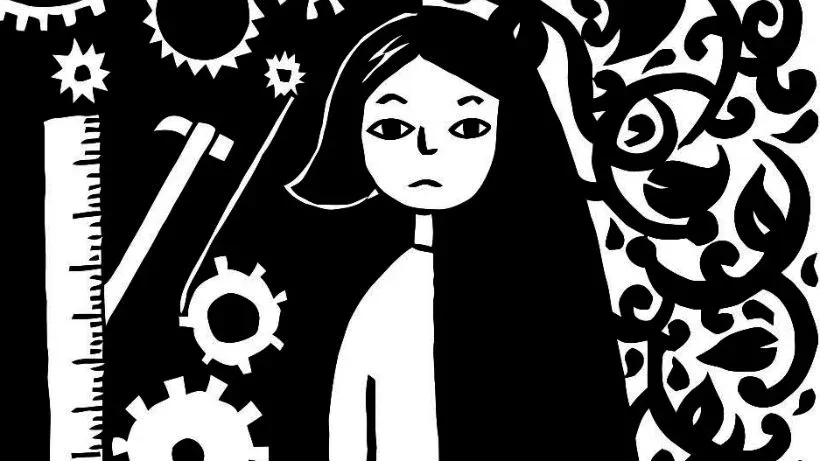
I enjoyed reading this book. Satrapi is an amazing narrator who managed to capture her complex and difficult life in an accessible book. Her voice shines as she describes her younger life in Iran, making kids like me relate, even though we have such different experiences. Her art style is eye-catching and simple, making it easy to follow the narrative. The discussions I had with the club, ranging from Islamic Fundamentalism to life in Europe, are ones I won’t forget. I’d recommend Persepolis to anyone curious about cultures beyond their own, or interested in how one voice can illuminate a country’s history. It’s a moving, unforgettable story that shows how political events shape personal lives, and how storytelling can bring us closer to understanding.
Review by Halriah Berkowitz:
Persepolis: The Story of a Childhood—written by Marjane Satrapi in French in 2000, then translated into English in 2003—is a graphic novel in which the author reflects on her adolescence before, during, and after the Islamic Revolution. The autobiographical novel focuses on her life from the ages of six to 14. These ages marked a period of major political and social transformation in Iran. The graphic novel dramatically and vividly illustrates the downfall of the Shah's regime and the subsequent move into the Islamic Republic, the Iran-Iraq War, and the impact these events had on Satrapi and her family.
The story centers on Satrapi, her family, and how their modern and secular beliefs were often oppressed in the newly conservative and repressive state they now lived in. Thus, Satrapi was forced to grow up very quickly. As a result, a significant amount of the book's plot revolves around her growth and how she grapples with the turbulent world around her. This includes: noticing the impacts of war and political oppression in Iran, navigating her identity and coming of age, and negotiating religion and freedom.
While reading, I found the formatting of the book hard to follow, and some of the writing felt lost in translation, which made it confusing to read. In addition, the book has a multitude of sensitive and potentially triggering subjects, such as violence and death, swearing and sexual content, suicidal ideation and idealization, as well as religious extremism and substance use.
While Persepolis is widely praised for its unique graphic novel formatting and historical significance, I found it difficult to connect with. The storytelling felt disjointed at times, and I struggled to stay engaged with the narrative. Although Marjane Satrapi’s experiences are undeniably important, the book did not resonate with me on an emotional or literary level. These feelings could stem from the fact that I do not share the same experiences and that I have not had to face many of the same injustices as Satrapi. That said, I recognize that it offers valuable insight into life during the Islamic Revolution, and I can see why it holds meaning for many readers—even if it wasn’t the right fit for me.











Loading Comments...