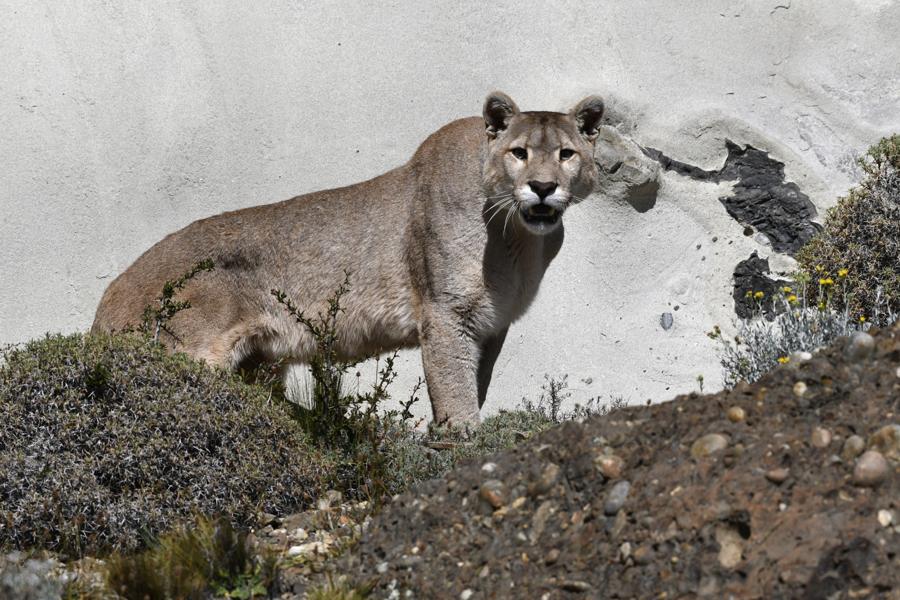
Why Are Pumas Hunting Penguins in Patagonia?
by Brooklyn Miller, age 12
Pumas are elusive wild cats, who can easily adapt to a variety of different climates, ecosystems, and prey. While these pumas are located in Patagonia, a region found in South America, pumas can be found generally around South America. However, the behavior of these Patagonian pumas seemed unusual, leading the scientists to conduct further research.
The Patagonian pumas used to be native animals until they were forced out by sheep ranchers in the 20th century. In the pumas’ absence, animals had adapted to the new reduced hunting pressure, specifically a group of Magellanic penguins who, in normal conditions, were usually confined to offshore islands, had established a mainland breeding colony with roughly 40,000 breeding pairs. However, after Monte Leon National Park was established in 2004, the pumas had already started to steadily make their way back. That is when researchers started noticing penguin remains in the pumas’ waste. Researchers dismissively thought it was only a few pumas continuing to eat the penguins, until they noticed that there were many puma sightings near the penguin colony.
The issue is that these pumas, usually solitary cats, had changed their behavior. They were living closer together, tolerating each other more, and having far more social interactions. The pumas mainly hunted these penguins as they were easy prey in breeding season, and even more so with their widening range. The fact that the penguins had only moved offshore when it was breeding season may suggest that the pumas’ descendants had hunted those penguins, so why have their interactions changed now?
Scientists started researching the pumas by using cameras to estimate how many have been living near the breeding colony, which was a 1.2 mile stretch of beach inside the National Park. Then, tracking collars were put on fourteen pumas, investigating penguin kill sites between 2019, and 2023. They noticed that nine of the fourteen pumas hunted penguins, while the other five did not. Those first findings surprised researchers: how the pumas had changed so oddly after eating the penguins, and how they even ranged twice as far when the birds migrated offshore for summer. This surprised them even more so, because they had expected the two species to live without confrontation after they had formerly been absent, perhaps thinking that their ranges for prey had changed.
The findings were quite odd, leaving both scientists and researchers in confusion. The penguins, having just moved into easy hunting territory, were an easy kill, so obviously the pumas had instinctively been immediately interested in the unsuspecting penguins. But why had the unfortunate prey completely changed the pumas’ social interactions? All of it was very strange. However, one thing was clear: the two species certainly did have confrontations, the pumas were obviously interested in the penguins, and for good reason, seeing how easy prey they were. Reintroducing a species after another one, more importantly prey, had moved in to easy kill sites was not the best circumstance to hope that they would live peacefully. In the returning of a formerly absent species, no matter what scientists thought would happen, surely they expected even slight changes? People should expect changes from a reintroduced species, this situation being a good example of why.
[Sources: LiveSciencePlus; National Geographic]











Loading Comments...