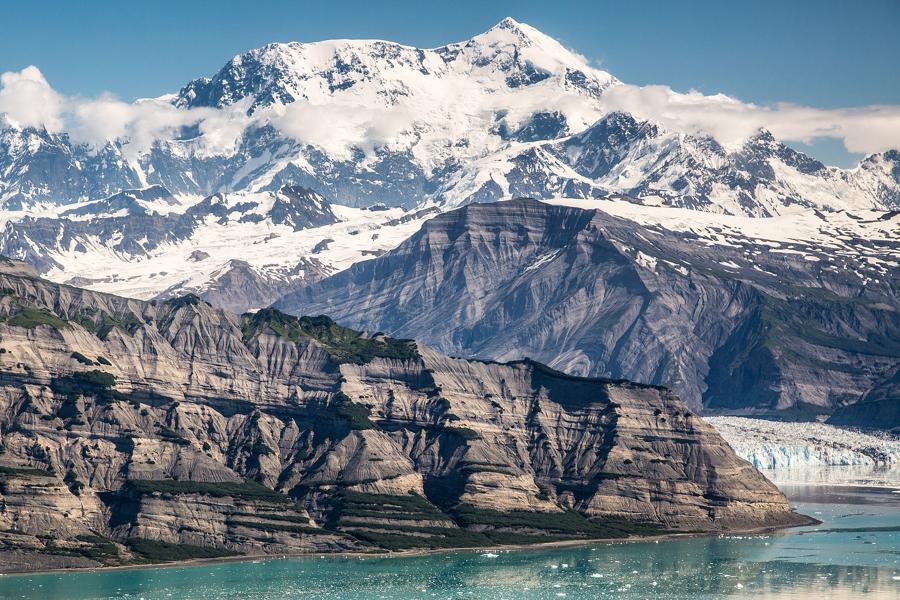
Mount St. Elias Remains One of North America’s Most Dangerous Peaks
by John Agbo, age 14
Despite being the second-tallest peak in both the U.S. and Canada, the treacherous Mount Saint Elias remains virtually untouched. Sitting on the border between Canada and Alaska, at a remarkable 18,008 feet, it is a unique terrain. Interestingly, more climbers have reached the summit of Mount Everest, at 29,032 feet, than of Mount St. Elias.
Mt. St. Elias is situated between Kluane National Park in Canada and Wrangell-St. Elias National Park in Alaska which are a nationally protected land. Despite its high elevation, plant life – including lingonberries and arctic bell heather – and wildlife such as moose, beavers, caribou, and mountain goats, can be found up to around 10,000 feet.
Due to the subarctic climate and varying temperatures at lower elevations, along with prolonged periods of harsh weather and rocky terrain, there is no direct path to the summit. Additionally, small ice cap climate zones exist at higher elevations, with tundra climate zones covering most of the mountain. Ice cap zones are characterized by frigid temperatures, typically never rising above freezing temperatures. In contrast, tundra zones can experience higher temperatures, ranging from -30 to 50 degrees Fahrenheit. Mount St. Elias is also difficult to climb due to the region's irregular volcanic terrain, which is formed by some of the largest volcanoes in the area. These volcanoes are accompanied by massive ice fields, which contain the largest concentration of glaciers in North America, where violent snowstorms are quite common.
With numerous disasters occurring on its slopes, a notable one is the ice bay landslide, nicknamed by the National Park Service (NPS) “The Day it Rained Rocks,” which was caused by a single boulder that gave way, unleashing over 150 million tons of debris. It was so grand that NPS said, “For perspective - rubble taken from the collapsed Twin Towers amounted to 1.5 million, requiring over 108 thousand truckloads to cart away. Multiply that by 100, imagine it hurtling down a steep mountainside, and you can begin to get the picture.”
In 1897, the Duke of Abruzzi, an Italian explorer, led an expedition to the summit of the mountain. They packed two months' worth of food and supplies. After finding the safest route, they began their ascent on June 22 and returned 50 days later on August 11. During their journey, they faced harsh conditions that hospitalized some team members, and they even discovered tracks supposedly made by a puma. The duke and his cohorts became the first ones to reach the summit on July 30 and planted the royal Italian flag.
Mt. St. Elias may not be the tallest mountain, but it is certainly more dangerous than other, taller peaks. Attempting to climb it is an extremely challenging endeavor.
[Sources: bplant.org; World Atlas; National Park Service]











Loading Comments...