How a Plane Crash, a ‘Heretic’ Doctor, and a Bold Invention Saved Thousands of People from Blindness
by Sedona Afeworki, age 16
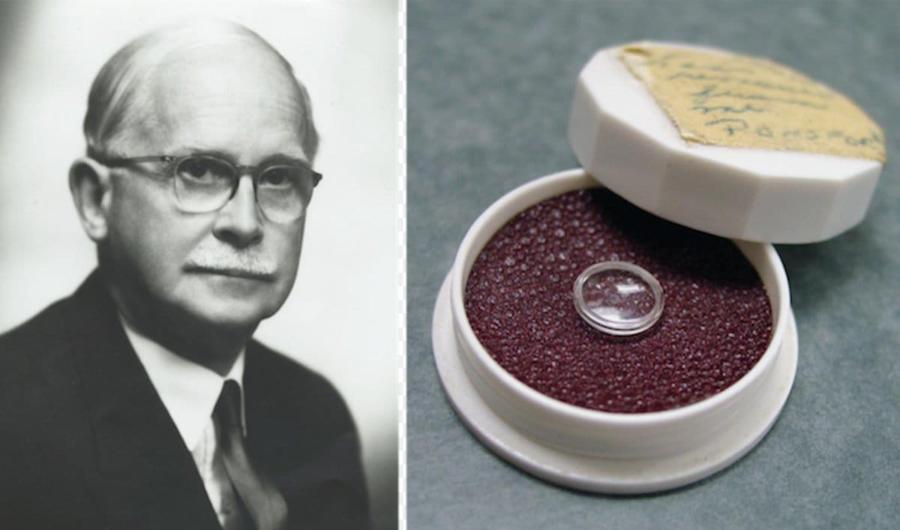
An intraocular lens is an acrylic disk inserted into the eye when a cataract is removed. A cataract is a clouding of the lens of the eye, which is typically clear. Cataracts can form due to a variety of reasons such as aging, genetics, exposure to ultraviolet radiation, smoking, and high alcohol consumption. An intraocular lens is a crucial medical device that preserves vision for thousands of people around the globe. But this wasn't always the case.
Gordon Cleaver was a well-respected British Air Force pilot during World War II. However, while on duty, his plane was shot at and his canopy – the plexiglass over the pilot to protect them – was shattered. The broken plexiglass flew into his eyes while he was in the air and he parachuted from his plane because of the pain. He was alive, but at the cost of his eyesight.
Harold Ridley was the ophthalmologist who looked at Cleaver’s eyes and found pieces of plexiglass embedded in them. Back then, the only procedure and solution was the removal of the eye entirely; however, Ridley realized that Cleaver’s eye was not inflamed or infected. Because of this, Ridley did not want to remove Cleaver's eyes and wanted to keep inspecting them.
Ridley had a realization while taking out a cataract from a different patient. A medical student watching the procedure said, “It’s a pity you can't replace the cataract with a clear lens.” This quote opened his eyes, and he realized that this could actually be possible.
Normally, after the cataract procedure, people would wear huge, thick glasses, which restored only limited vision. Doctors at the time did not believe that inserting plastic into the eye could be a viable solution. But Ridley was sure that this could be accomplished. With help from Rayner & Keeler and Imperial Chemical Industries, they created a "natural" lens made from acrylic.
An artificial lens was successfully put into someone's eye in 1950. Ridley continued perfecting the procedure, helping some people recover 20/20 vision. Despite this success, other ophthalmologists called him crazy and a heretic. He retired in 1971 having failed to convince the world that his ideas had merit.
But, when a new generation of ophthalmologists started exploring Ridley's procedure in the 1980s, they realized his idea was sound and lens implants became more common, even standard. Over the years the procedure has helped thousands of people regain near 20/20 vision.
As for Ridley, it took decades, but he was finally recognized for his discovery and was knighted by Queen Elizabeth in 2000 at the age of 93. But what about Gordon Cleaver, whose injury inspired Ridley? He received an intraocular lens in 1987, after undergoing cataract surgery.
[Sources: The Wall Street Journal; Johns Hopkins University; Smithsonian]











Loading Comments...