The Woman Who Dedicated Her Life to Gorillas
by Lucas Abiy, age 9
Dian Fossey had fulfilled her dream of working and living with gorillas while helping save the species.
Dian Fossey was born on January 16, 1932, in San Francisco, California.
During Fossey’s early life, her parents divorced when she was only six years old. Even though she loved animals, her stepfather banned pets, making her life lonely and depressing at a young age.
Her stepfather refused to pay for her education, but Fossey was supported by her aunt and uncle. They covered her training expenses to become an occupational therapist. Fossey worked at many hospitals before moving to Louisville, where she eventually became director of the therapy department.
For many years, Fossey was interested in the mountain gorillas of Rwanda after reading numerous studies by George B. Schaller. This allowed Fossey to plan an academic trip to Rwanda in 1943. During her trip, she met Dr. Louis Leakey, a paleontologist studying primate fossils to better understand human evolution.
Fossey was nervous when she first saw gorillas. Immediately, she was struck by the physical magnificence of the huge jet-black bodies blended against the green palette of the thick, fresh forest foliage. A couple of years later, she met Leakey again at a conference in the United States. He was looking for someone to take a long-term job researching gorillas in the Republic of the Congo, and he chose Fossey. In 1966, Leakey sent Fossey to the Republic of the Congo, but the political situation in Rwanda was very unstable, so she took refuge in Rwanda.
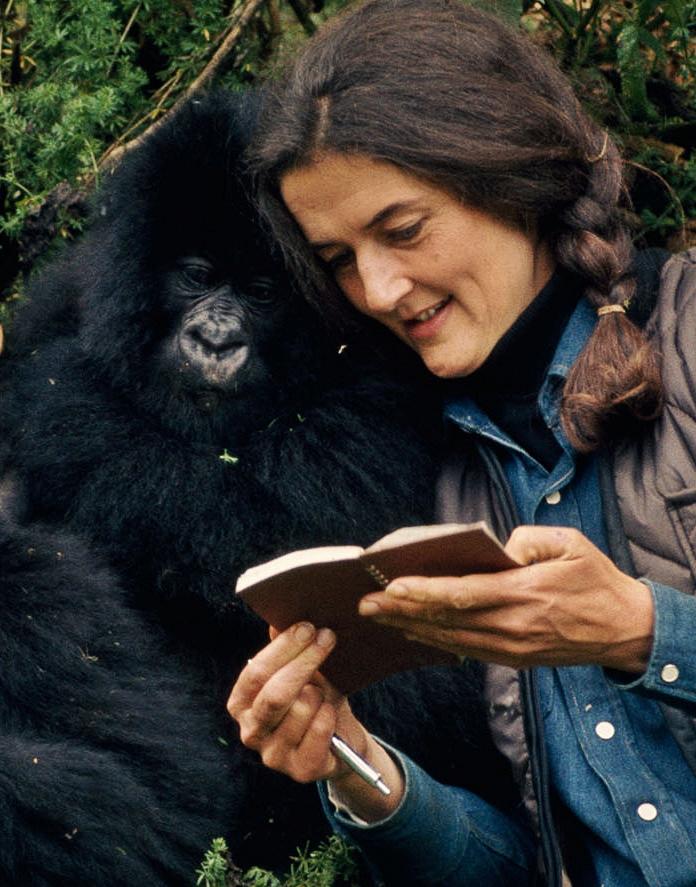
With funding from the National Geographic Society, she established the Karisoke Research Center in Virunga National Park. The center became a research hub and Fossey’s platform for international attention. Fossey became close to the gorillas, lived with them, made friends with them, and gained their trust. She became emotionally attached saying, “I feel more comfortable with gorillas than humans.” She discovered that gorillas all have different personalities. Her closest relationship was to Digit, a baby gorilla.
Fossey was always worried about the idea of the gorillas being an easy kill for hunters and poachers in the region. The gorillas were often killed for their feet, hands, and bush meat. Many gorillas were orphaned through poaching.
As much as Fossey loved animals, she realized that she needed academic credentials to further extend her work. She returned to Rwanda in 1973 and realized she was spending far less time in the field; however, she needed to spend more time at headquarters.
The 1970’s were hard for Fossey due to loneliness after finding out that Digit died because of poachers in 1978. This was a turning point for Fossey, spurring her to launch an international campaign against poaching. Authorities began patrolling the area, listing suspects and offering bounties and rewards. Fossey started arming her students with guns and other weapons. She took matters into her own hands.
Fossey changed the general image of gorillas from fierce, mean, and scary to gentle, calm beasts, all while raising awareness and helping the gorillas.
[Source: Women Who Changed the World]











Loading Comments...