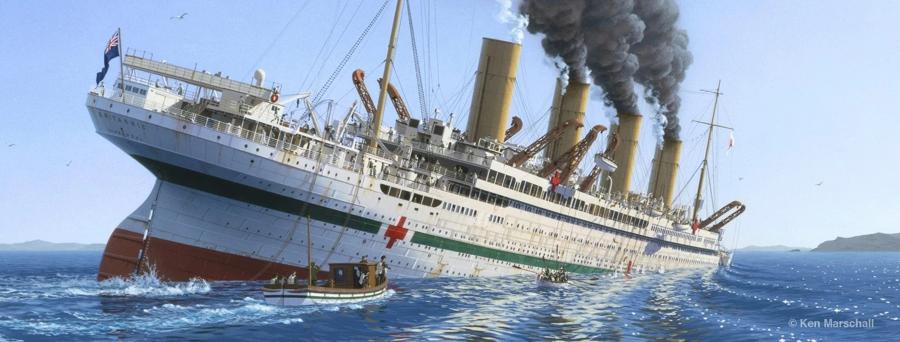
Britannic Served as a Hospital Ship Before Its Tragic Sinking
by Leo Wilson, age 12
The Britannic, originally called the Gigantic, was a ship made by the White Star Line, the same company that made the infamous Titanic. The ship was built in 1914 in the Harland and Wolff shipyard, located in Belfast, England. It was originally going to be an ocean liner, but the British government required it to be turned into a hospital ship due to the start of World War I.
The HMHS (His Majesty’s Hospital Ship) Britannic had many rooms that the crew used to house soldiers. After the Titanic disaster on April 15th, 1912, the White Star Line (passenger liner corporation) was taking no chances with the Britannic, so they increased their watertight compartments to 17 and added many lifeboats.
The Britannic had many differences from its sister ships, the Titanic and the Olympic. The most notable is how the Britannic was turned into a hospital ship. Another difference is that the Britannic sank due to an underwater mine and had six voyages, unlike its sister ship, the Titanic, which tragically made only one voyage. The Britannics' last stop was in Queenstown, Ireland.
The ship sank on November 21, 1916, when it foundered off the coast of Greece near Kent island. The Britannic took 55 minutes to submerge; by the time the ship was completely submerged, it was 9:07 AM. The number of people that died on the Britannic was 50 times less than on the Titanic. Despite the Britannic's going underwater at a rapid speed, the incident took the lives of only 30 people, whereas the Titanic had 1,500 deaths on board.
The Britannic is not very well known due to its sister ships, the Titanic, which took most of the spotlight, and the Olympic being the second most well-known. Soldiers in World War I benefited from it being a hospital ship due to its size and capabilities. This ship stands as a reminder of early naval engineering and highlights the legacy it had during desperate times.
[Source: Encyclopædia Britannica; National Museums Liverpool]











Loading Comments...