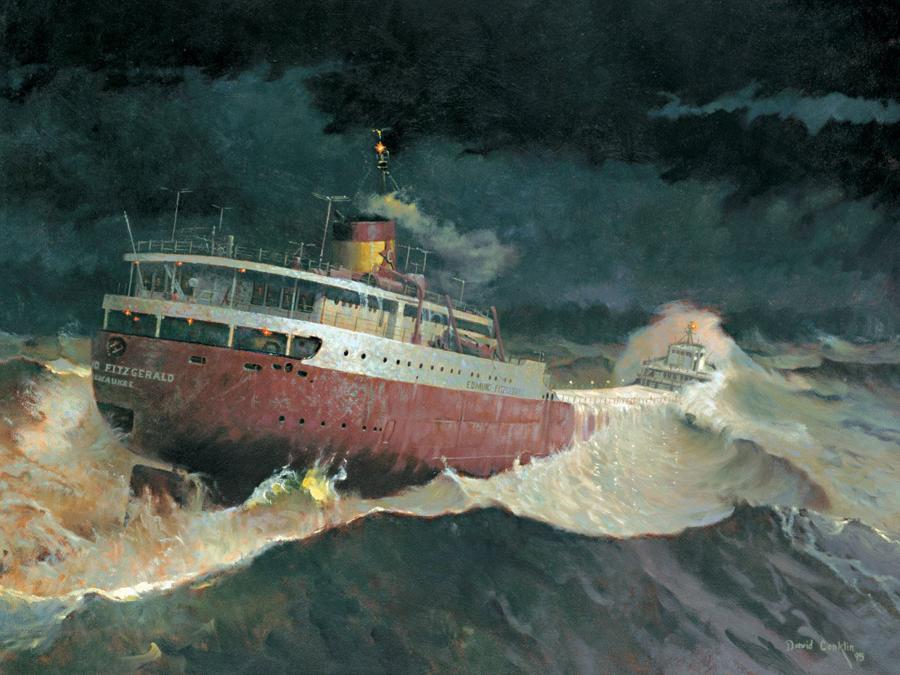
After 50 Years, the Story of the Edmund Fitzgerald Remains a Mystery
by Will DeFour, age 16
Fifty years ago, the Edmund Fitzgerald sank on its way from Superior, Wisconsin to Detroit, Michigan. It remains the largest shipwreck on the Great Lakes.
A “maximum-sized” Great Lakes ore carrier, at 729 feet, named after the chairman of the Milwaukee-based company that contracted it, the Edmund Fitzgerald launched on August 7, 1957. It was the largest ship on the Great Lakes until 1971. The Fitzgerald spent its career on the Great Lakes carrying small iron pellets called taconite from mines near Duluth, Minnesota, to steel mills near Detroit.
For six years, the ship known as Big Fitz was captained by Peter Pulcer. He was a “D.J. Captain” who played music over the intercom near Detroit, and entertained viewers with facts about the vessel while it passed through narrow locks connecting the big lakes. All this helped the Fitzgerald gain a reputation long before its infamous sinking.
On November 9, 1975, the Edmund Fitzgerald set out on the final voyage of its 17-year career. The Fitzgerald left Superior carrying over 26,000 imperial tons of taconite, to Zug Island, an iron-processing industrial zone near Detroit that played a crucial role in the steel industry of the United States. Captained by Ernest M. McScorley, the Fitzgerald promptly joined up with the Arthur M. Anderson. The two ships connected by radio and stayed within 10-15 miles of each other for most of the voyage.
Though storms occur over the Great Lakes throughout the year, the most dangerous storms form during the month of November. Humidity and heat from the Gulf of Mexico create the necessary conditions for storms, low pressure systems. The National Weather Service warns that simultaneously in the north, “Arctic air masses from Alaska and Canada surge over the Rockies and plains states more frequently.” This combined with the Great Lakes’ "relatively warm waters” causes severe storms to sweep the Great Lakes at this time of year.
The storm that sank the Edmund Fitzgerald formed in a similar manner. A low-pressure system from Kansas moved across Iowa and Wisconsin, stirring up severe thunderstorms. On the water, ships recorded sustained wind speeds of 30-45 knots. On November 10, the winds around the Fitzgerald were at 58 knots, with gusts of up to 70 knots. Waves were 18-25 feet high throughout the worst of the storm, and some peaked at twice that height.
Both captains knew about the approaching storm. Both elected to hug the northernmost shore of the lake, with the Canadian coast to protect them. By afternoon the Fitzgerald had passed Michipicoten Island and was approaching Caribou Island. Many historians believe it was here, on the shallow shoals of Caribou Island, that the ship suffered severe damage.
McScorley contacted Captain Bernie Cooper, of the Anderson, as he slowed the Fitzgerald to allow the Anderson to catch up. “Anderson, this is the Fitzgerald. I have a fence rail down, two vents lost or damaged, and a list. I’m checking down. Will you stay by me till I get to Whitefish (Bay)?”
The ships maintained constant communication until 7:10 pm, when the Fitzgerald sent its final message. “We're holding our own.”
The Arthur M. Anderson remained vigilant throughout the storm. Its radar consistently lost, then regained a reading on the Fitzgerald. The Anderson’s radar lost the Fitzgerald only five minutes after its last transmission. Cooper was dealing with problems of his own, as huge waves assaulted the sides of his ship. At times, there was up to 12 feet of water on the deck of the Anderson. After two large waves hit the Anderson, Cooper watched as they rolled across the lake and toward the Fitzgerald.
“Then the Anderson just raised up and shook herself off of all that water – barrooff – just like a big dog. Another wave just like the first one or bigger hit us again”, Captain Cooper would say later. “I watched those two waves head down the lake towards the Fitzgerald, and I think those were the two that sent her under.”
As his worries increased, Cooper contacted the Coast Guard at 8 p.m. After an hour, the Coast Guard began its search, and the Anderson reached Whitefish Bay. At that time, Cooper received a call from the Coast Guard. Despite making it to Whitefish Bay, the crew on the Anderson was not out of the woods yet. At 9 p.m. the Coast Guard asked Cooper to go back out into the storm … and find the mighty Edmund Fitzgerald.
Cooper responded with reasonable fear. “Ah… God, I don't know… that sea out there is tremendously large.” They then discussed the situation. “Do you realize what the conditions are out there?” asked Cooper. The Coast Guard told him they did, and they would leave the decision up to him. “I’ll give it a try, but that's all I can do.”
The Anderson led the search into a now relatively calm Lake Superior. They found debris and two empty lifeboats, yet no survivors. Four days later, according to the National Shipwreck Museum, “a U.S. Navy Plane equipped with a magnetic anomaly detector located a strong contact 17 miles northwest of Whitefish Point. They had found the Edmund Fitzgerald.
On the Fourth of July in 1995, the Fitzgerald's bell was retrieved from the wreckage. It is now at the National Great Lakes Shipwreck Museum. The sinking of the Edmund Fitzgerald remains a mystery. Fifty years later, the tragedy still fascinates historians and captures the imagination of the American public.
[Sources: Great Lakes Shipwreck Museum; National Weather Service; Popular Mechanics; Wayne State University; Michigan State University]











Loading Comments...