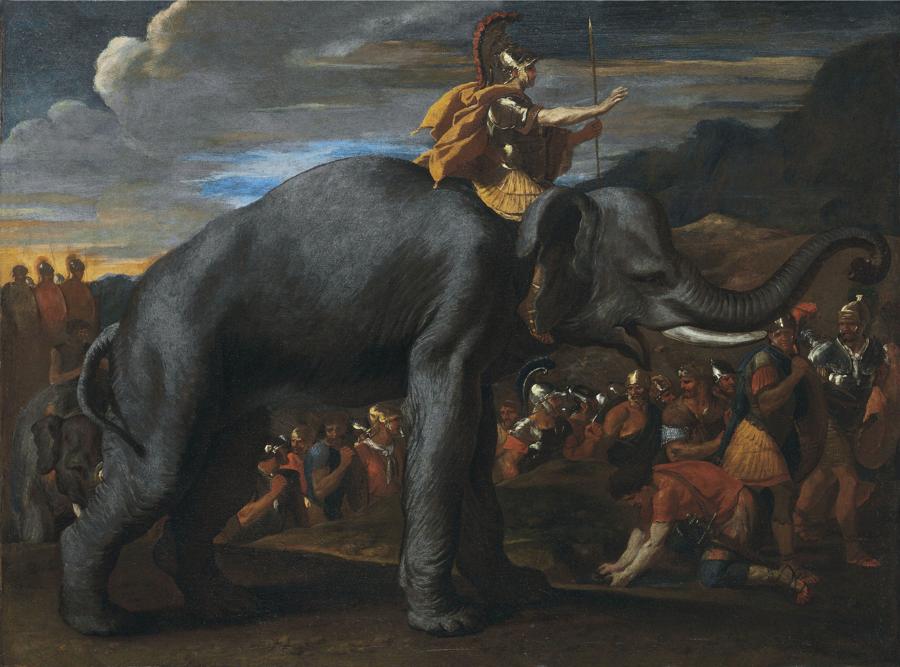
Hannibal Barca: The Carthaginian General who Terrorized the Roman Republic
by Ruben Becerril, age 13
Hannibal Barca was a Carthaginian general known for fighting against Rome in the Second Punic War. He is considered one of the greatest generals, as well as the first general to cross the Alps with a full army.
Hannibal was born in 247 B.C.E and died around 183 B.C.E. Son of the legendary Carthaginian general Hamilcar Barca, he was taken to Spain by his father at a young age. At the Temple of Baal, his father made him swear eternal hostility to Rome. Throughout his life, Hannibal faced constant struggle against the Roman Republic.
Hannibal’s first commands in the military came from General Hasdrubal the Fair, his brother-in-law and the successor to Hamilcar. Hannibal was such a successful officer that when Hasdrubal was assassinated, the government had Hannibal take his place.
Hannibal wanted to strengthen Carthage’s control over Hispania. He married an Iberian princess and conquered various tribes in the peninsula. In the year 219 B.C.E, Hannibal invaded Saguntum, an independent city in Iberia south of the Ebro River. In the treaty following the First Punic War, the treaty set the Ebro River as the border between Roman and Carthaginian influence. However, there was a problem; Saguntum was south of the Ebro, meaning it should have been under Carthaginian influence, but Saguntum was allied to Rome. After Hannibal took over the city, Rome declared war on Carthage, starting the Second Punic War.
After he crossed the Ebro, as well as the Pyrenees Mountains and the Rhône River in 218 B.C.E, Hannibal’s only option to march into Rome was by crossing the Alpine Mountains. While crossing the Alpine Mountains, his army was reduced from 90,000 infantry, 12,000 cavalry, and 37 elephants to 20,000 infantry, 6,000 cavalry, and most of his original elephants. He did not have as much manpower to fight Roman consul Publius Cornelius Scipio. As a result of his need for more soldiers, he needed to have a major victory over Rome to have the local tribes switch to his side, as the local tribes strongly disliked the Romans.
Using his superior Numidian cavalry, he was able to defeat Scipio, who was wounded and had to be saved by his son of the same name. Then, Hannibal defeated consul Sempronius Longus at the Battle of the Trebbia River. These two extraordinary victories attracted Gallic and Ligurian tribes to aid Hannibal in hopes of plundering Roman cities. In the spring of 217 B.C.E, Hannibal was able to reach the Arno River. Along the way, he lost his right eye to an infection.
The same year, Hannibal was able to defeat consul Gaius Flaminius at the battle of Lake Trasimene, where the losses were approximately one to ten between Carthage and Rome. Following this battle, the Roman Senate was in chaos. In a time of crisis, the Senate elected Fabius Maximus to be dictator instead of having two consuls.
Despite the fact that Fabius Maximus was dictator, the Senate strongly opposed his idea, dubbed the Fabian strategy. This was where the Roman army would run away from Hannibal instead of fighting him head-on. This strategy was considered ignoble and not Roman.
Despite this major victory over Rome, Hannibal refused to march on the city. Instead, he waited for Rome’s provinces to switch to Hannibal’s side and rebel, which would make Rome surrender. The Battle of Cannae in 216 B.C.E was brutal; around 20 percent of male Roman fighting men were slaughtered in the battle alone. It was only after this battle that the Senate used the Fabian strategy, which helped them hold off Hannibal and restrengthen the Republic. Following Cannae, it looked like Rome was losing, as Hannibal’s plan to have the provinces rebel was working. Yet Rome did not surrender.
Because the Senate was now using the Fabian strategy, Hannibal was confined to southern Italy, constantly having to interfere with the attacks of his allied cities, and unable to attack the Roman army. Between 213 B.C.E to 209 B.C.E, Rome recovered the cities of Casilinum, Arpi, Syracuse, and Tarentum.
While Hannibal was stuck in the Italian Peninsula, Rome started gaining major victories in their counterattack in Hispania that started a year before Cannae. Following the death of Publius Cornelius Scipio in 211 B.C.E, his son took command of the counterattack the following year. Even though he was doubted for being under the legal age to command an army, Scipio’s success in Hispania effectively ended Carthaginian control.
In 207 B.C.E, Hannibal’s brother, Hasdrubal Barca, attempted to cross the Alps. While he was successful in crossing the mountains, he died in battle in the same year. Following Hasdrubal’s death, his severed head was delivered to Hannibal’s camp. The loss of his brother demoralized Hannibal, reportedly leaving him to lament, “There lies the fate of Carthage.”
Publius Cornelius Scipio was elected as a consul for Rome in 205 B.C.E. He won approval to take the fight to Africa, forcing Hannibal to return to the mainland. The battle of Zama was the final battle of the Second Punic War, where Publius Cornelius Scipio and Hannibal Barca faced off. The result was the defeat of Hannibal and the surrender of Carthage, ending both the war and Hannibal’s military campaign in the Italian peninsula. After winning the battle, Scipio was given the name “Scipio Africanus,” which meant “The African.”
Even after the end of the Second Punic War, Hannibal continued to oppose Rome. He reformed the Carthaginian government in a way that would lower corruption and reduce inefficiency. These changes angered the government and sent Hannibal into exile: first to Tyre, then to the court of Antiochus. He was welcomed at first, however, after raising and commanding a fleet, he lost a naval battle against the Romans. Then in 190 B.C.E, Antiochus was defeated by the Romans, and one of the terms in the peace treaty was the surrender of Hannibal. This meant Hannibal had to flee again.
After fleeing from the Romans, he took refuge with King Prusias of Bithynia who was at war with Rome’s ally, King Eumenes II of Pergamum. Roman influence had expanded to a degree where they were in a position to demand the surrender of Hannibal. Expecting a betrayal, Hannibal Barca poisoned himself as one final act of defiance against the Roman Republic.
[Sources: Encyclopædia Britannica; Atlas of World History]











Loading Comments...