How Ancient Egyptians Made Mummies
by Marco Flores, age 10
The mummification process was a type of ritual performed in ancient Egypt to preserve a deceased body for the afterlife. While many may have heard about mummies, few know about their significance in ancient Egyptian culture or the process of mummification.
Mummies are deceased Egyptians covered in wrappings and put in a yellow or red shroud. Many types of mummies existed in ancient Egypt, each with its purpose. For instance, Ushabti was a mummy that was tasked with things to do in the afterlife. The Egyptians would also mummify dogs, cats, food, and birds for them to experience the afterlife. The food was preserved in this fashion with the idea that people could enjoy it in the afterlife – it was known as a “virtual mummy.”
If one were to be an emperor, king, or ruler, they would be buried in the Valley of the Kings. There, they were buried in shrines and glass cases covered in ancient art. Today, the Valley of the Kings is located at the Great Pyramids of Egypt.
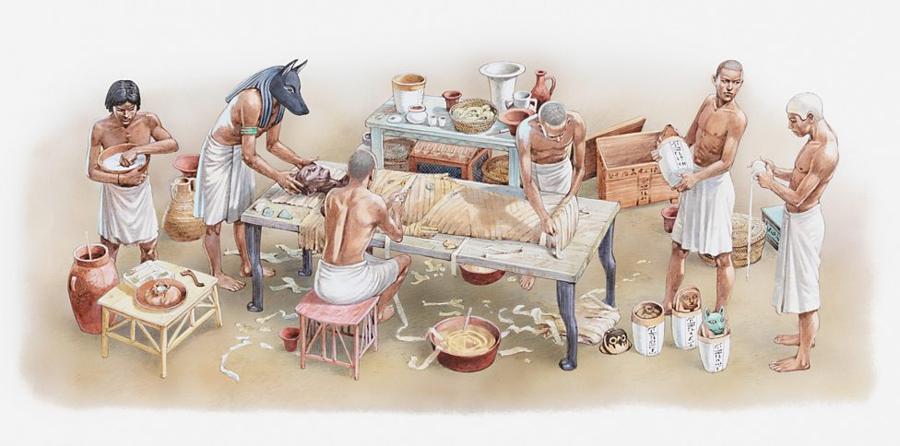
Mummification was a long process. The first step to make a mummy was to wash the body with Nile water. This water came from the Nile River which was considered sacred because it was used to grow local crops. Next, an examination called exacerbation was performed on the mummy. For this step, a tool known as a “brain hook” was used to extract the brain pieces out of the body. This tool was slanted on an end to allow it to go into the nose. The hook was inserted into the nostril and one by one, the Egyptians would pluck out pieces of the brain.
After extracting the brain, Egyptians would follow by removing all the organs in the body except for the heart. This was because the Egyptians believed the heart was the seat of the mummy's thoughts. Each mummy was placed in four canopic jars: the Duamutef jar, the Hapi jar, the Imseti jar, and the Qebehsenuef jar – these jars represented the four eyes of Horus. Next, the body was covered with salt and left for about 40 days until all moisture was eliminated. This was done because it prevented the mummy from decaying. Following the dehydration process, perfumed oils and plant resins were rubbed on the body. Finally, linen straps wrapped the body together.
Sometimes, a mysterious pouch – perhaps of religious significance to the mummy – was placed on the chest. A Mummified Ibis, a wading bird with a curved down bill, was placed on the abdomen. This symbol is signified as a votive to the god Thoth. More wrappings were performed around the body before it would be placed in a shroud.
Sometimes the Egyptians would paint the shroud red, only a few red shroud mummies are known to exist. After they finalized the shroud, they would possibly paint the shroud with symbols of protection and write the mummy's name at the feet. Additionally, a beetle and eagle amulets were placed with the mummy which symbolized a safe passage and existence in the afterlife.
Finally, the mummy was placed in a sarcophagus for protection. At last, the Ba would be reunited with the mummy, the Ba represented the personality of the deceased, and every night it had to be with the mummy.
Today, mummies are present in various museums to understand their significance and ancient history. Mummification was an important practice in Ancient Egypt and reflects the religious and spiritual beliefs of these ancient communities.
[Source: Milwaukee Public Museum]











Loading Comments...