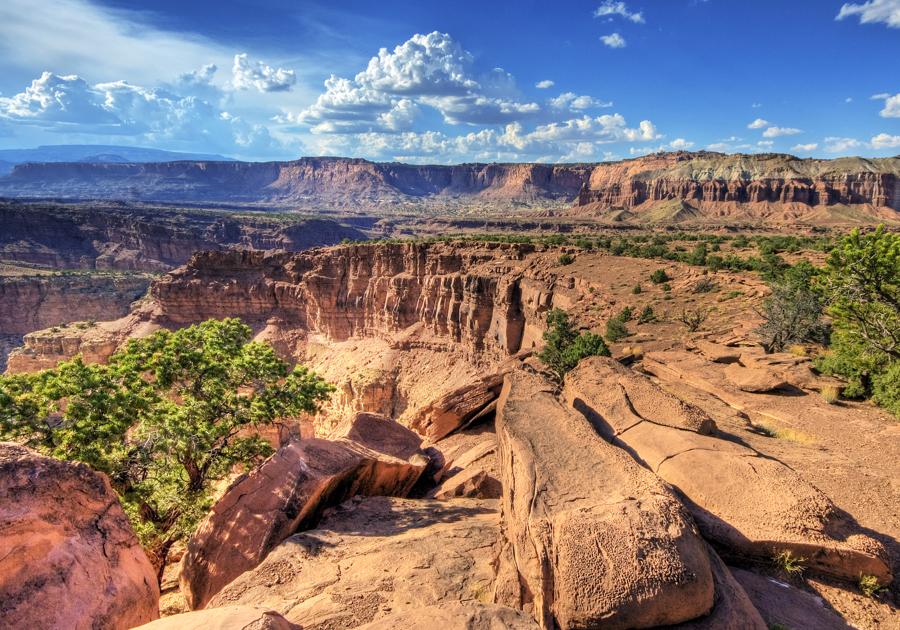
Preserving the American Landscape: The History of the National Park System
by Theodore Morrison, age 18
National parks such as Yellowstone, the Badlands, and Arches, serve to protect the natural beauty of our environment. The creation of the American national park system has a complex history, full of political turmoil and fierce lobbying by conservationists. People often credit President Theodore Roosevelt with the system’s creation; however, it is the culmination of many people’s efforts.
President Ulysses S. Grant created the first national park in 1872 when he signed the Yellowstone National Park Act. At the time, many people were concerned that natural resources in a national park would be off limits. Without these valuable resources, the public worried the government would be denying them substantial economic opportunities. As a result, only a single, now-defunct national park was created in the 18 years after the establishment of Yellowstone.
President Benjamin Harrison was a staunch conservationist. As a U.S. senator in the 1880s, he pushed for the Grand Canyon to become a national park, to no avail. On September 25, 1890, Harrison signed a law creating Sequoia National Park in California. Sneaking a provision into the Homestead Act in 1891, Congress provided the president with the power to create forest reserves through executive order, something that would allow the federal government to limit logging in designated areas.
Harrison, without support from Congress to create national parks, decided to use his new power to create 15 forest reserves, covering 13 million acres. Having previously failed to establish the Grand Canyon as a national park, he designated it as a forest reserve, allowing him to protect its forest. Throughout all these efforts, Harrison made a substantial contribution to the preservation of natural beauty in America and the conservation of nature.
President Theodore Roosevelt was deeply involved in the conservation movement, starting with his formation of the Boone and Crockett Club in 1887 when he was a civilian. The organization was full of conservationists, ranging from nature lovers and scientists to the political elite of New York City. The Boone and Crockett Club was able to lobby Congress for more regulatory enforcement regarding national parks and to expand Yellowstone to protect more land. When he became president of the United States following President William McKinley’s assassination, Roosevelt reduced the size of some forest reserves. He said voters had not elected him to enact his vision of conservation. He instead used his influence to lobby Congress to pass conservation-focused bills.
In order to gain public support for the national park system, Roosevelt embarked on the Great Loop Tour, during which he traveled around the country while drawing attention to national parks. During the trip, Roosevelt campaigned for public support, delivering a widely viewed speech at Yellowstone which followed a two-week-long vacation in the park. During the same tour, he visited the Grand Canyon, which was yet to be made a national park, and he made a speech calling for the creation of a new national park to protect the unique geological site.
In 1906, the Antiquities Act was passed, allowing the president to “preserve buildings in small areas of historic and scientific purpose.” The wording was intentionally vague, allowing Congress to pass what they thought was a narrowly constrained power, meanwhile granting the president a power to protect several sites in a manner Congress did not intend. Roosevelt put this power to great use, designating Devil’s Tower as a national monument. His most significant move with this newfound authority was naming the walls of the Grand Canyon as a national monument, citing its great historic and scientific value.
While Roosevelt was not able to live long enough to see the Grand Canyon be named a national park, his impact on our national park system has been tremendous. He stood by his conviction that we should protect these pieces of natural beauty in our country. Roosevelt was not the only contributor to the national park system’s history. Presidents like Grant and Harrison paved the way for Roosevelt, and a number of other conservationists supported Roosevelt as he campaigned for his vision. The national park system persists today because of the dedication of many people across history that cared for the conservation of nature.
[Sources: National Park Service, Grand Day Tours, Washington Department of Fish and Wildlife]











Loading Comments...