The History Behind Wisconsin’s First People and Statehood
by Siwoo Park, age 12
Wisconsin, the state known for cheese-making and cranberries, has a much more complex history than agriculture. From tribal civilization to its current residents, Wisconsin has experienced many developments.
Before European settlers discovered Wisconsin, Paleo-Indians, the ancestors of modern tribes, inhabited the area around 12,000 years ago. Their existence is confirmed by effigy mounds, which are burial mounds shaped like animals or figures often representing the decedent’s connection to the creature. About 20 mounds survive in Madison today.
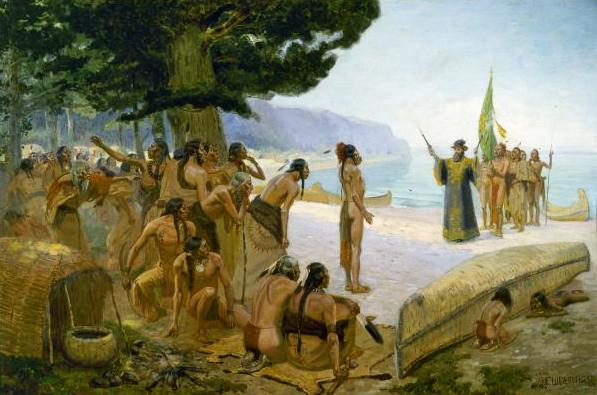
During the 1600s, Europeans who reached the region known as Wisconsin met various Native Americans. They encountered the Fox, Ho-Chunk, Sauk, Illinois, Miami, Mascouten, Ojibwa, Menominee, Kickapoo, Potawatomi, Huron, Ottawa, and Santee Sioux. Throughout history, these tribes would be reduced to the Ojibwas, Menominee, Ho-Chunk, and Santee Sioux as wars and political reasons drove them away. During the 1820s, four other Native American tribes traveled to Wisconsin. They were the Stockbridge and Munsee bands of Mohicans, the Brotherton, and the Oneida.
French explorers mainly roamed Wisconsin with Jean Nicolet being the first documented European to do so. Their main interest was fur trading rather than agriculture or treasure hunting. Pierre-Esprit Radisson and Médard Chouart Des Groseilliers first established the fur-trading business in modern-day Wisconsin. In 1755, during the French and Indian War, Wisconsin tribes under Officer Charles Langlade obtained the victory for Britain. The Treaty of Paris then made Wisconsin part of the British colonies in 1763. In 1787, about a decade after the American Revolution, the Northwest Ordinance made Wisconsin an American territory.
In 1804, President William Henry Harrison’s treaty with the Indians drove them away. This led to the Black Hawk War, which lasted until 1832. Between this, the Winnebago War began in 1827 but ended in four months. The construction of the State Capitol began in 1837. On May 29, 1848, President James Polk signed a bill that accepted Wisconsin as a state. By 1850, Wisconsin’s population totaled about 305,000 people. Domestic migrants were mostly from New England and New York, while international immigrants were from England, Germany, Ireland, Scandinavia, and Scotland.
It is amazing how Wisconsin built itself to be a remarkable part of American history. Wisconsin fought hardship and wars, and it continues to grow even today.
Note from Cris to Publications Department: Cross-link Max’s Black Hawk War Article and Atisse’s Wisconsin State Capitol article.
[Sources: Wisconsin Legislative Reference Bureau; Encyclopædia Britannica; Wisconsin Historical Society]











Loading Comments...