The Potawatomi Nation's Trail of Death
by Ayelen Flores, age 15
The Potawatomi Trail of Death resulted from the idea that Native Americans did not have the right to live alongside the white settlers. In 1838, white settlers removed the Potawatomi from their home in Indiana. The trail of death was a forced march that resulted in the deaths of many members of the Tribe. The anti-Native American sentiment among settlers emerged following the conclusion of the Black Hawk War.
The Black Hawk War was a significant conflict between the U.S. and the Sauk, which ended with tragic losses. Many white settlers despised Native Americans because of the Black Hawk War. Although the Potawatomi Tribe was peaceful and was not part of the war, they were not welcomed by white settlers. The settlers started to create new changes and implement new laws on Native Americans.
In 1819, the U.S. government wanted to “civilize” Native Americans. Congress created a new law that allowed the use of $10,000 for tuition toward mission schools for Native American children. Many of these schools were located in Indiana. The government said these schools were beneficial to the students; however, the President failed to use any of the money provided by the new law.
Additionally, Native Americans had new problems. In 1822, under the new law, traders no longer had to register with the Indiana government. It led to irresponsible and depraved traders being allowed in the tribal grounds. They traded whiskey for fur, meaning the local tribes did not benefit financially. Many missionaries and friends of Native Americans asked the government to help increase funds for reservations.
After two years, another law was passed on July 9, 1832, that created a new service for Native Americans. This law allowed councils of white settlers to advise tribes to convince them to relocate beyond the Mississippi River. Years later, at the start of September 1838, General John Tipton called a meeting with the leaders of the Potawatomi Tribe to discuss their removal. However, the removal was not up for discussion because Tipton was given the task of removing the remaining Potawatomi population. Indiana Governor David Wallace had a strong belief that the Potawatomi were not able to live next to a “civilized” American population and had no other option but to leave Indiana.
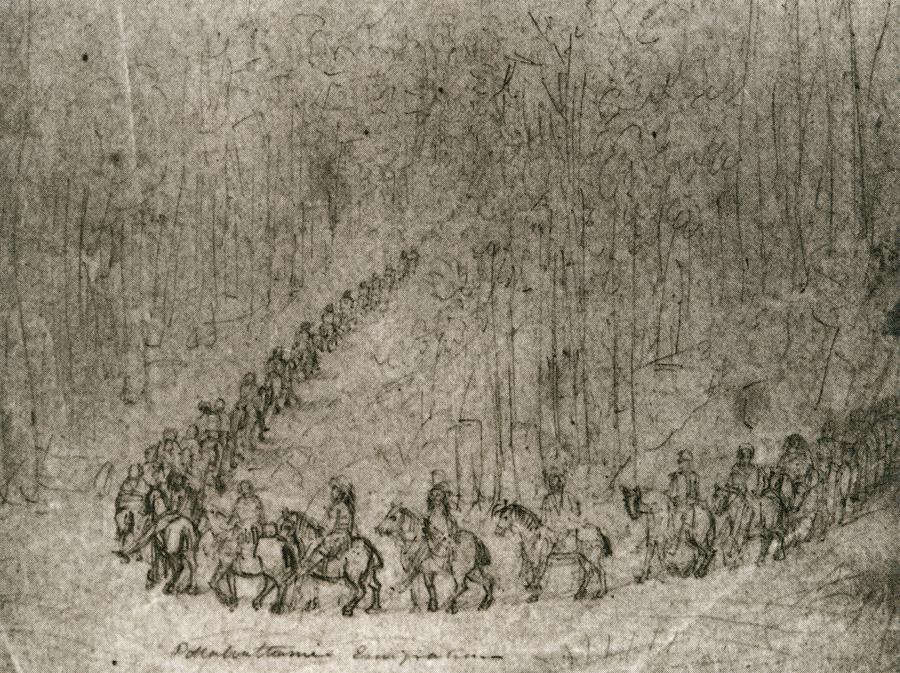
The morning of September 4, 1838, was a horrific day. Leaders of the Potawatomi Tribe were tied up to the back of a wagon. With a group of 859 Potawatomi members, they were forced to move away from their homeland to what is now Kansas. White militia members burned fields and homes after the last wagon departed in hopes of preventing the Potawatomi from escaping and returning home. It was a 660-mile march that the Potawatomi were not ready for. With excessive heat and a lack of resources, the group’s health deteriorated. Members, most of whom were children, began to die. Families had to leave their bodies in hastily dug graves along the trail. 42 people died during what the Potawatomi came to call the Trail of Death.
[Source: Potawatomi Heritage]











Loading Comments...