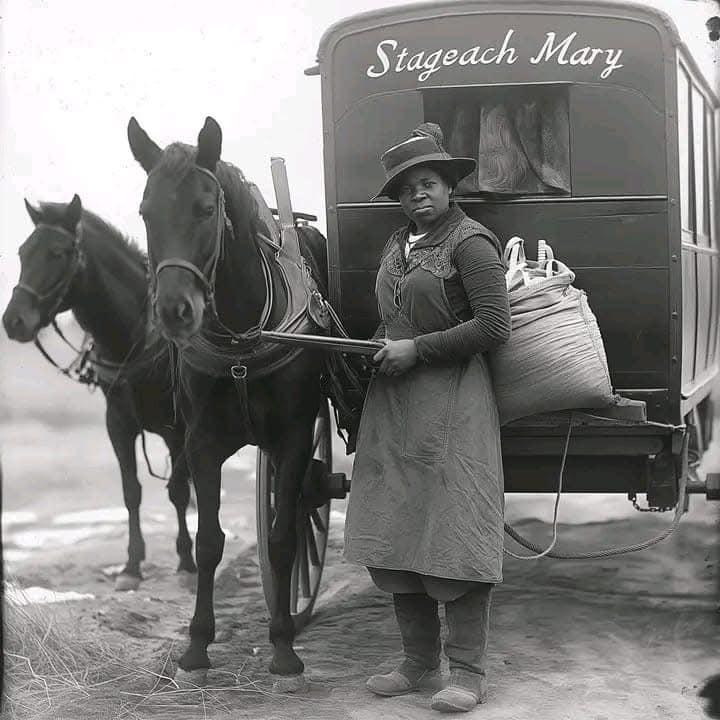
Mary Fields Was the First Black Woman Mail Carrier
by Aubrey Bevenue, age 14
Stagecoach Mary Fields was a complex woman with many contrasts, hardships, and successes. She stood six feet tall and was strong, so many people made sure to stay away from her. She drank, smoked, carried a gun, and had a wild temper. Mary was the first African American woman to carry mail as a Star Route Contractor (SRC) for the United States.
Mary Fields’ birthday is unknown, but we do know that she was born into slavery between 1832 and 1833. Leading up to the Civil War, she worked for the Warner family in West Virginia before she was emancipated in 1863. Later, she moved from West Virginia to the Mississippi River and worked on steamboats.
Mary Fields ended up in Toledo, Ohio, where she began working at the Ursuline Convent of the Sacred Heart. While there, she washed laundry, bought supplies, managed the kitchens, and grew and maintained garden grounds. Mary was known to yell and lose her temper with anyone who stepped on her freshly cut grass. What is known is that Mary’s rough style was not the best fit for the serene calm that was the convent.
Although it is unknown why Mary Fields left Toledo, many historians think she went to tend to an ill friend. Mother Amadeus Dunne, who was Mother Superior in Toledo, headed West, where she became sick. Mary and Mother Amadeus were known to be good friends. Although this claim is not fully proven, many records show that their friendship dates all the way back to Mary’s time working for the Warren family in West Virginia.
When Mary arrived in the West, she started working, mainly for Saint Peter's Mission near Cascade, Montana. The mission was run by Ursuline nuns and was where Mother Amadius Dunne lived. Here, she continued many of the same jobs she had in Toledo. Including maintenance and repair work, gardening, and laundry. A major job Mary was a part of was locating and delivering supplies for the mission. Although she had no official contract with the nuns and missions, she was free to come and go as she pleased and took additional work outside any missions.
However, Mary was unfortunately let go from the mission. This dismissal was a result of her behavior, unruly temper, and constant drinking and smoking with men in saloons. The last straw was an argument between Mary and a male mission janitor. They got into a fight and both drew guns. Although neither fired their weapons, Mary's actions were enough to make the Bishop of the area lay her off. Mary later moved to Cascade itself and tried to open one or more eateries, but failed. It is believed the eateries failed because she allowed people who could not pay to eat for free, which was a result of her generosity and big heart. Mary also reportedly set up a laundry shop and did odd things for money. Around that time, her drinking, gun toting, and smoking were well-known to the people of Cascade.
In 1895, in her early sixties, Mary acquired a contract from the United States Post Office Department to be a Star Route Contract (SRC). Mary was the first African American woman and the second woman to receive an SRC. The contract was possible, thanks to the Ursuline nuns, who helped Mary because they felt connected to her and wanted to see her thrive.
Mary built a fearless reputation as a mail carrier. Her job was not only to deliver mail but also to protect it from thieves, wolves, and harsh weather while doing so. She was nicknamed “Stagecoach Mary” because she used a stagecoach as transportation. Mary was also widely recognized for her guns: a rifle and a revolver.
She spent over eight years with the Postal Service as an SRC. During that time, she became loved by the people of Cascade for being fearless and generous to children. Mary retired in the early 20th century and settled in Cascade. After retiring, she attempted once again to open a laundry business and eatery while this time, babysitting local children. Mary grew famous and even became the baseball team's mascot. Mary was loved so much that she could drink in saloons and stay at hotels for free.
Unfortunately, Mary died on December 15, 1914. After her death, townspeople raised money to have her buried on the road where she frequently traveled. Her funeral was the biggest in town. Mary’s legend grew to the point where she symbolized female Black empowerment. Although she drank and wore men's style clothing, she became the first African American woman in the SRC during a time of a particularly discriminatory, white-dominated society. The challenges Mary overcame and her service as the first Black female SRC show her relentless character and lively personality.
[Sources: Smithsonian National Postal Museum; The Gazette]











Loading Comments...