A Massive Meteorite Exploded over Russia in 1908
by Joseph Zheng, age 11
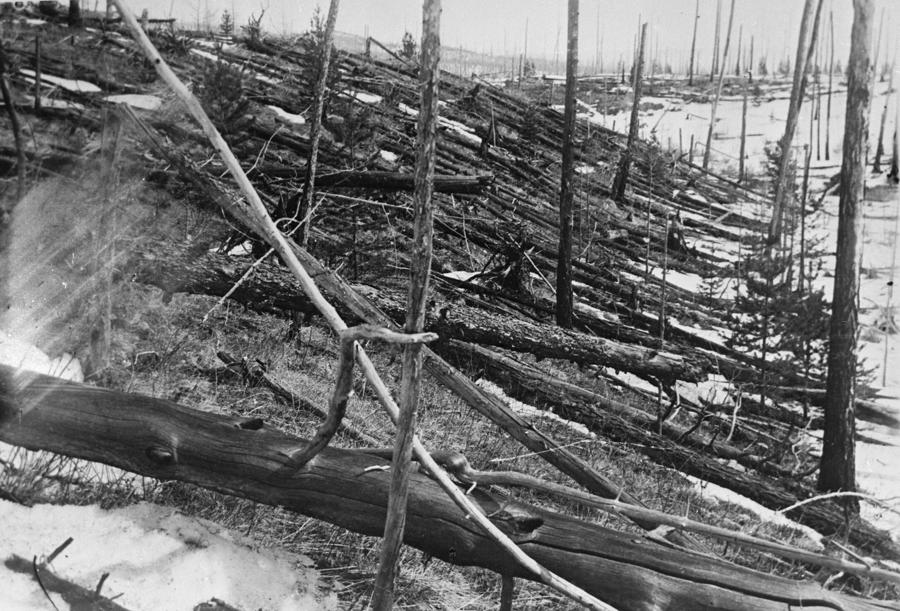
On June 30, 1908, at around 7:15 a.m., a large fireball-like object was spotted in far eastern Russia. It soared across the sky until it made contact with the ground, creating an explosion that caused trees to fall like dominoes. The impact sent small objects flying as forest fires began to spread across the crash site. This event in history is called the Tungunska event.
The asteroid was as large as a football field, 300 feet in diameter. After the collision, it sent shockwaves hundreds of miles away and released gases, causing bright skies during the starry night. Although the outburst was huge, no one explored it until about 20 years later due to its remote location.
Only a few farmers were able to watch the explosion. There were three possible related deaths, however, if there was a city nearby at the time of the event, damage and casualties would have been severe. Due to World War I, the investigation of this event was delayed.
The site was finally explored in 1927. Scientists found a vast forest of burned and knocked down trees. Over 800 square miles of forest were damaged or destroyed. The scientists were able to follow the knocked-down trees straight to the blast site. That area was a smooth, treeless field in which no fragments of the object remained. Scientists think that the object exploded mid-air and vaporized before it had a chance to hit the ground.
Scientists found microparticles, but they were not specific enough to prove whether it was an asteroid or a comet. Most scientists believe it was an asteroid that rained down on Siberia. Researchers proclaimed June 30 as Global Asteroid Awareness Day.
The Tunguska event is one of the largest explosions the world has ever seen, although the circumstances around the object are not fully known. The explosion impacted the Earth and gave us information about the mysteries of the universe. Grigoji Richers, a co-founder of Asteroid Day said, “Asteroids teach us about the origins of life, but they can also impact the future of our species and life on Earth.”
[Sources: NASA; Encyclopedia Britannica]











Loading Comments...