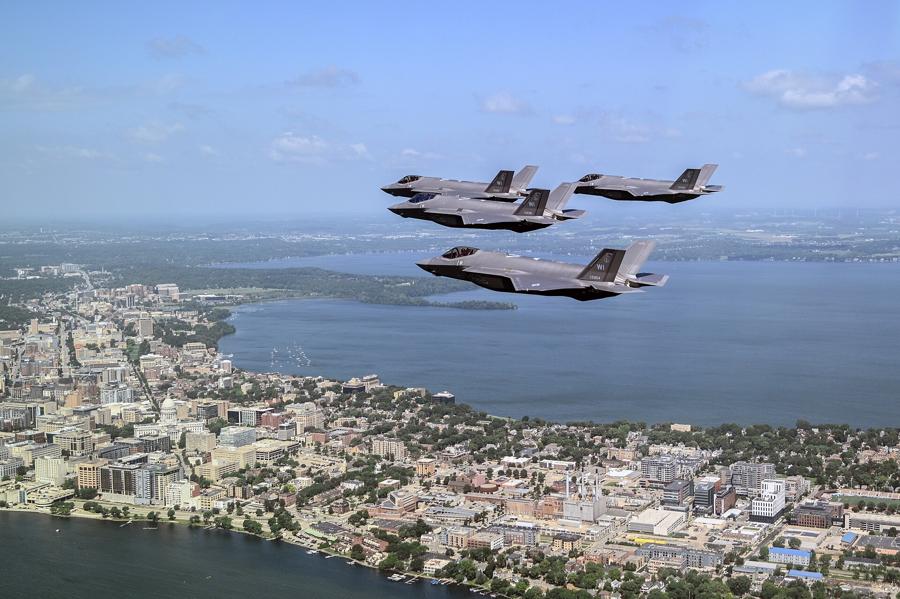
Fifth-Generation Aircraft Bring New Strengths to Modern Air Combat
By Niko Sayu, age 12
In recent years, the United States Air Force, Navy, and Marine Corps have begun phasing out older yet still highly capable aircraft in favor of newer jets with lower payload capacity. At first glance, the switch may not make sense to some: why take a collection of tried-and-tested, still-relevant aircraft and replace them with slightly newer ones just because of the tag “fifth-generation”? Well, the answer does not come down to raw power, but rather a slew of special abilities that set them apart. One of these abilities is low-observable (LO) technology, or, in simpler terms, stealth.
While stealth may sound like a simple concept, beneath the surface, there is much to reveal. Military aircraft use advanced radar to identify and track other planes within a certain radius. A radar system emits electromagnetic radio waves in pulses of varying sizes through a transmitter usually in the nose of an aircraft. When these waves come into contact with another object, they reflect off it, revealing its general shape, size, and location through a receiving device to identify and track the specific aircraft, and therefore determine whether it is hostile. However, this can be blocked and or exploited in a number of ways. The first is LO technology, which uses strategies such as coating the aircraft with radar-absorbent materials, which significantly reduce the reflection of radar waves off the aircraft. This is part of what makes planes such as the F-35 and F-22 so lethal. An alternative LO method is to create a series of slanted surfaces that shape the body of an aircraft to deflect radar waves and minimize reflections, as seen on the F-117 Nighthawk. Another technique is radar jamming: radar jammers transmit noise at frequencies intended to confuse enemy radar. If used well, jamming can be a highly effective battlefield tactic from a safe distance. This is commonly featured on aircraft carriers and on aircraft with an “E” designation, such as the EA-18G and E-2 Hawkeye.
Another significant feature is advanced communication tactics and technology.
Fifth-generation aircraft (especially the F-35) have intricate data sharing platforms to spread potentially critical information to pilots in the area immediately, so that allied forces can respond quickly.
The F-16 served at the 115th Fighter Wing in Madison, Wisconsin, for many years and still serves at other bases in the U.S. The F-16 is a fourth-generation, non-stealth aircraft that is still highly effective today. It is fast, has relatively low production and maintenance costs, and is highly agile. Even with these upsides, it is nowhere near as advanced as the F-22 or the F-35. For these reasons, however tried, tested, and combat-proven the A-10, F-16, F-18, and older F-15 models are, they are being phased out.
The U.S. Air National Guard has installations in every state for various purposes. One of the roles of the Air National Guard is to support the Active Duty Air Force. They must always be ready to act if necessary. This is why the F-35’s fly over Madison. It is not a “sky police,” but rather a test of readiness. Additionally, they conduct training missions with the Milwaukee-based KC-135 aerial refueling tankers to be best prepared for long-range flights.
No matter how reliable and capable some fourth-generation fighters are, fifth-generation aircraft inevitably have the edge under most circumstances. This is why we need newer planes. As for why we need them at all, that is for the sake of constant operational readiness.
[Sources: JEM Engineering, Joint Base Langley-Eustis, Lockheed Martin, JAPCC.org]











Loading Comments...