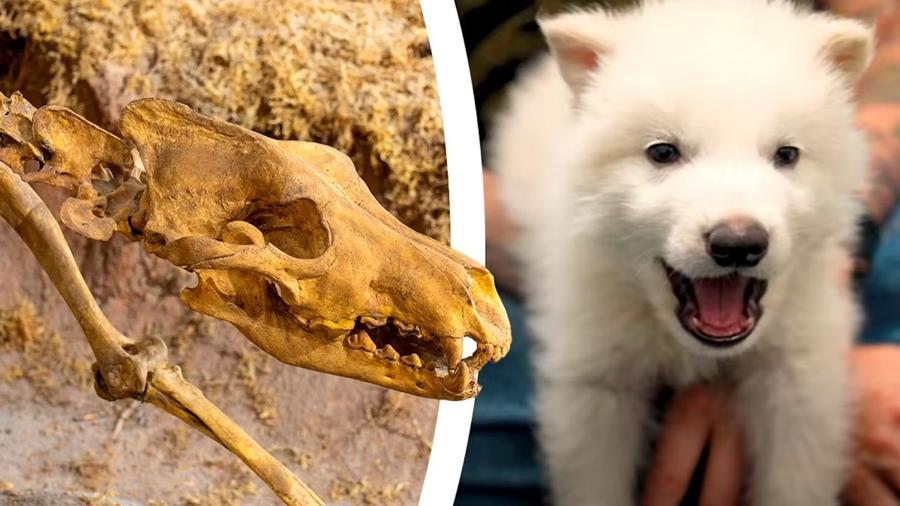
Scientists Clone 13,000-year-old Wolf Species
by Will DeFour, age 15
Thousands of years ago, dire wolves were the apex predators of North America. With white fur and a large, muscular build, they could take down the behemoths of the Ice Age. They went extinct long ago, but scientists at Colossal Biosciences are using gene editing technology to recreate something not seen in over 13,000 years, a species they call “dire wolves.”
Colossal was founded in Dallas in 2021, with grand plans to “de-extinct” the Tasmanian tiger, dodo bird, and legendary woolly mammoth. Colossal uses a gene editing technology called CRISPR to make this possible. Their co-founder and head of genetics, George Church, developed the first genomic sequencing technique and helped innovate stem cell engineering and genome editing. He is now a professor at Harvard and the Massachusetts Institute of Technology.
Colossal employs over 130 scientists and is valued at $10.2 billion. This value is mainly due to their first great scientific leap, the de-extinction of the dire wolf.
“We are an evolutionary force at this point. We are deciding what the future of these species will look like,” said Beth Shapiro, the chief scientific officer at Colossal.
The dire wolves were genetically engineered by editing the DNA of gray wolves, the closest living relative to the dire wolf. Colossal used dire wolf DNA preserved in a 13,000-year-old tooth and a 72,000-year-old skull to complete their understanding of the animal's genome.
Due to its age, the dire wolf DNA could not be used directly for cloning. Colossal worked around this by editing DNA from gray wolf blood cells. Colossal aimed to edit 20 genes, but decided to only edit 15 because those final five edits could lead to genetic defects such as loss of hearing or sight.
Though they share the phenotype, or physical attributes of the dire wolf, the wolves are still slightly different genetically. They share just over 99.5% of their DNA with dire wolves.
One big difference between Colossal’s new wolves and their 13,000-year-old counterparts is that they weren't raised by dire wolves. They never learned how to hunt with a dire wolf pack, take down giant animals, or eat an Ice Age diet.
Colossal Biosciences has also cloned four red wolves, the most endangered canid in the world. Additionally, in Australia, they identified a single edit that could protect the endangered quoll from going extinct due to an invasive, toxic frog species.
Many people agree that saving endangered species is a just cause, but controversy arises when it comes to resurrecting the beasts of the Ice Age. Dire wolves died off because the behemoths they hunted, like woolly mammoths, went extinct when the world warmed up after the Ice Age. Critics say bringing these animals back to an even warmer world would be futile if we don't stop the constant production of greenhouse gases that are rapidly turning up the heat.
Colossal has genetically engineered dire wolves and pushed the boundaries of science even further. As our scientific powers grow, we must choose to use them for the betterment of life as we know it.
[Sources: CBS; National Geographic; Los Angeles Times; Time Magazine; The New York Times]











Loading Comments...