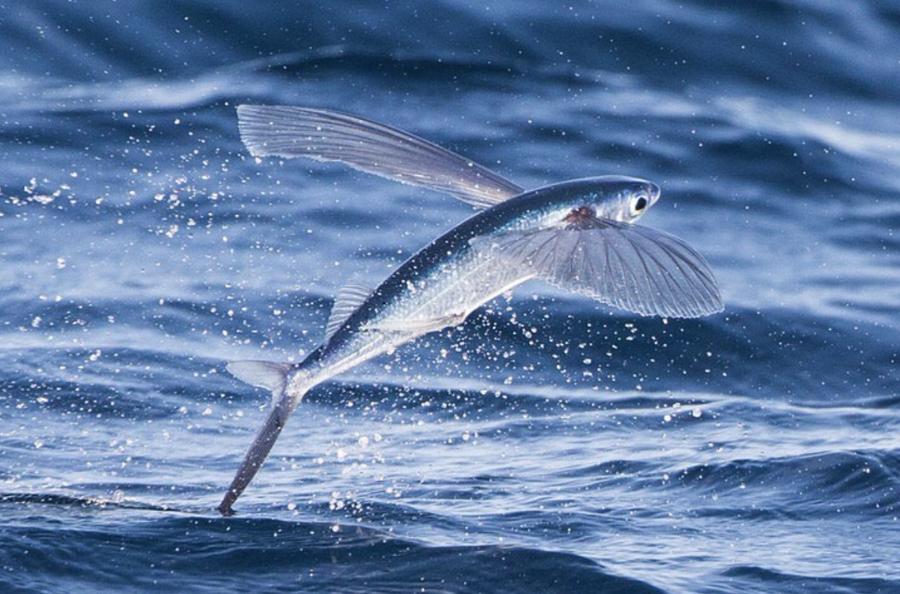
Flying Fish Use Fins to Soar Over Oceans
by Ermiyas Abiy, age 10
Some people might think that flying fish can fly after hearing their name. However, they actually glide through the air! They do this by speeding underwater, at a speed of up to 35 miles per hour, and then launching themselves with their pectoral fins up to 650 feet in the air.
There are approximately 40 different species of flying fish. They live in the Atlantic, Pacific, and Indian oceans, and sometimes are found on the outside of coral reefs. Clear, open oceans make great habitats for these tropical flying fish.
Flying fish primarily consume plankton as well as small crustaceans. Although they don’t have a wide variety of food, they have a lot of predators. Their predators are tuna, swordfish, mackerel, marlin, bigger fish, and fishermen. The fish willingly hand themselves over by jumping into fishermen’s nets and boats as they are drawn to well-lit boats.
Baby flying fish have whiskers that look like a plant blossom, which allows them to camouflage and hide from predators. They also use their unique flying mechanism to fly away from predators, sometimes only to become prey for birds.
Another unique body feature is their uneven, forked tail. Their tails are like a snake's tongue, but the bottom lobe is bigger than the top. Flying fish are about seven to 12 inches long, but they can grow up to 18 inches long.
Flying fish are usually born near the surface of wide-open oceans. A female gives birth to a clutch of eggs that are connected with sticky, tiny strings referred to as filaments. These filaments are attached to something near the surface, like debris or seaweed, until they hatch to live an average lifespan of five years.
Flying fish have so many predators, yet their population is stable. This animal’s unique capabilities make them an amazing little creature.
[Sources: National Wildlife Refuge System; National Geographic]











Loading Comments...