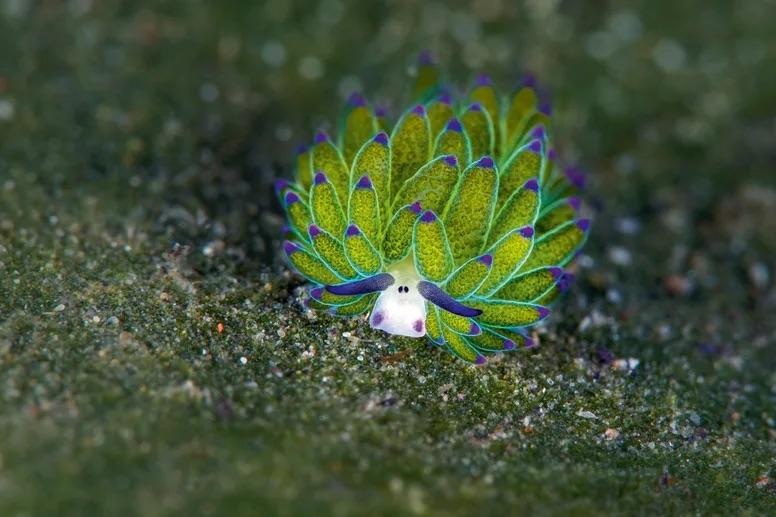
Sheep Leaf Sea Slug Uses Photosynthesis to Survive
by Dulce Vazquez, age 16
The sheep leaf sea slug was discovered on Kurashima Island, in Japan, back in 1993. It can also be found in the marine environments of the Philippines, Indonesia, Singapore, and Thailand. It has a unique feature only found in a few other animals.
Sea slugs have many small features. They can be a variety of different colors, including yellow, red, blue, green, white, and purple. Sheep leaf sea slugs typically have white faces with black eyes. A unique feature they have is their two rhinophores that look like ears. Rhinophores are organs that help find food and detect chemicals in water, such as algae. These slugs have green cerata (leaf-like appendages) around their upper bodies, which are used to help with respiration and defense.
Sheep leaf sea slugs absorb chloroplasts from algae. During this process, photosynthesis takes place, which is the process of turning light into food. They collect chloroplasts in their tissue. The chloroplast is gathered in their tissue for no more than ten days. Chloroplasts absorbed by the sheep leaf sea slugs help camouflage and create food. Due to the amount of chloroplasts in their bodies, the sheep leaf sea slug’s body has a green pigment. The chloroplast produces sugar, which can be used for extra fuel. This fuel can be used in egg production. Their eggs are shaped into spiral coils, and each coil contains 15-20 eggs.
Leaf sheep sea slugs face multiple survival threats, their habitat being one of them. Illegal fishing destroys animal habitats, although many people, including law enforcement, have attempted to stop it. Another issue is climate change. Warm weather affects marine areas, creating strong waves and sand hurricanes, which alter animal behavior. Plastic pollution is another risk. Plastics release chemicals that can affect their health. Microplastics can also damage the sea slug's mouth.
These sea slugs are important as they are one of the few marine animals that can perform photosynthesis. A better understanding of this species could deepen scientists’ knowledge of photosynthesis in animals.
[Source: BBC; EarthSky; Live Science]











Loading Comments...