Megalodon: Ancient Terror of the Seas
by Lincoln Roos, age 12
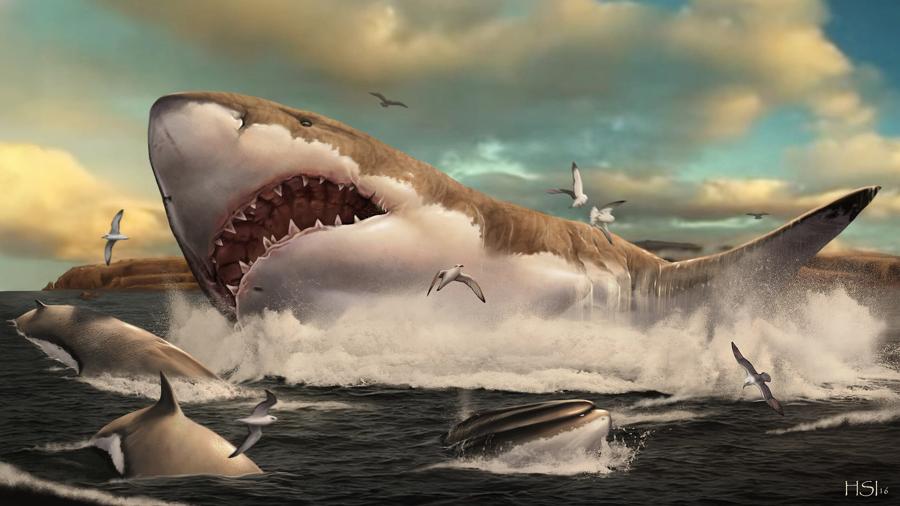
Most people have probably heard of a megalodon. If you have not, a megalodonis an extinct shark and was the apex predator of its time. Megalodons roamed the ocean about 3.6 million years ago. The megalodon’s appearance was that of a massive shark with an elongated and slender body. It had large pectoral fins and was as long as two school buses, weighing about 203,000 pounds. This shark moved around the ocean at two miles per hour.
Hollywood likes to envision megalodons as big great white sharks because of their similar-looking teeth. However, they have many differences: great whites have a more torpedo-like body with a thicker middle. They do not look the same, and they are not in the same lineage. Instead, it would look like a lemon shark; it has the same look as the megoladon but is much smaller.
A megalodon would typically live in tropical and subtropical areas around the world because it is much harder for them to live in areas with colder climates. Megalodons needed to eat an even larger amount of food. Megalodons ate prey such as whales, large fish, and even other sharks. A megalodon's pups grew up in shallow waters near the shore, and when mature, they moved into deeper water.
Megalodons have the largest teeth of any living or extinct shark. These teeth measure about one foot and six inches long. Their jaws were 8.8 by 11.1 feet, big enough to swallow two adult humans side by side. Their jaws could hold up to 276 teeth. With its massive jaw and large teeth, it has a bite force between 108,514 and 182,201 newtons. For comparison, humans only have a bite force of 1,371 newtons.
Even though the megalodon was around for a long time (23 million years), we still do not know much about it, because its fossils are hard to find. Their bones were made of cartilage, the same material human ears are made of, and did not fossilize well, so scientists have limited information they could get about the megalodon.
One thing they do know is why it went extinct: the world was getting colder. The ice forming around the shores of most countries destroyed baby megalodon habitats. Also, adult great whites were the same size and were faster than baby megalodons, and great whites thrived in open water. When baby megalodons were forced into open water where great whites lived, this made the megalodons the prey. All of this resulted in the megalodons' extinction.
Even though seeing and studying a megalodon would answer many questions scientists have, there is sadly no chance that they are still alive today. Someone would have
certainly seen them by now, and their teeth still would litter the ocean floor.
[Sources: The Natural History Museum, London; The Wall Street Journal]











Loading Comments...