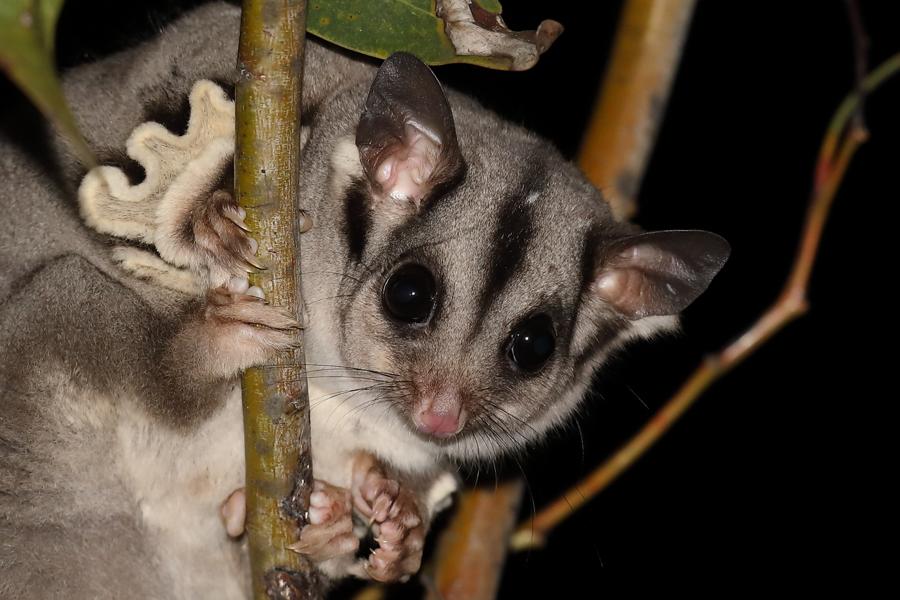
Sugar Gliders Are Tiny Flyers With a Sweet Tooth
by Ermiyas Abiy, age 9
This creature glides through the night sky but it's not a bat or owl. It is often mistaken for a flying squirrel. It's the sugar glider, a fascinating animal with a sweet tooth!
Sugar gliders get their name from their diet which mostly consists of sugar. Sugar gliders' sharp incisor teeth are very useful. The teeth allow them to bite into trees, and rip off the bark, which reveals juicy sap. They eat larvae, insects, gum, sap, fruit, pollen, and nectar. Since larvae and insects are considered meat, sugar gliders are omnivores. They are also marsupials, which means females develop their offspring outside the body in a pouch.
Sugar gliders can glide due to their patagium, which is the gliding membrane that stretches from the rear feet to their front feet. The patagium makes their limbs contiguous. When the animal is gliding, the membranes stretch out with the tail as it directs the sugar glider to land. The marsupial steers by changing the tension of each part of the patagium.
Just like all marsupials, female sugar gliders have pouches for their offspring. Mating season is usually in August in their homeland of Australia. However, in their other native land of New Guinea, they mate throughout the whole year. The marsupials can have approximately one to three joeys. In wild environments, sugar gliders live up to seven years.
Sugar gliders were first found around the border of eastern and northern Australia, and all of New Guinea. However, they were first found by European settlers who eventually showed the marsupial to Tasmania, a country around New Guinea.
This animal travels in groups and has scent glands that help other sugar gliders identify who is in their group. These glands are found in several parts of the body, such as the chest, tail, feet, pouch, and flanks.
The entire body, excluding the tail, is six to eight inches. The tail however, is around six to eight inches long too. The weight, which is also a small number in comparison to other animals, depends on the gender of the animal. A male sugar glider weighs 113 to 150 grams, while a female weighs about 100 to 135 grams.
This marsupial is very unique when compared to other animals. Its fascinating features along with its special skills make it an interesting species to observe and study in the wild.
[Source: The Encyclopedia of Animals]











Loading Comments...