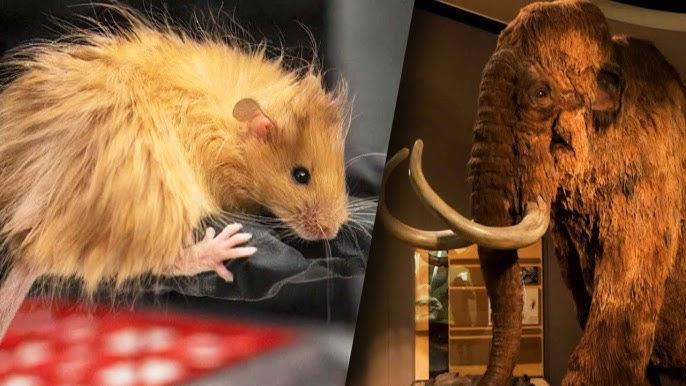
Might a Modified Mouse Make a Mammoth?
by John Agbo, age 14
Researchers have taken a preliminary step toward the potential revival of the prehistoric woolly mammoth. However, one must consider whether this endeavor signals a promising future for Earth, a misuse of advanced technology, or humanity's attempt to intervene in natural processes, essentially trying to play God, as mentioned by a professor at the University of Arizona (U of A).
Based in Dallas, Texas, Colossal Biosciences has successfully developed the first genetically modified “colossal woolly mouse.” This mouse features attributes such as thick fur and body fat typically found in woolly mammoths, representing the first step toward the company's goal to “de-extinct” prehistoric creatures.
To achieve this step, they made eight edits across a spectrum of seven genes, focusing on enhancing traits similar to those of woolly mammoths, particularly traits related to cold resistance, which they believe were crucial for the mammoth's survival in the tundra. They hoped for at least one mouse to exhibit characteristics akin to a mammoth, such as golden hair. The final product, however, was just a regular mouse with a few changes.
Colossal Biosciences also claims to have supposedly “brought back” the dire wolf, using DNA from a skull and tooth of the ancient beast. The grey wolf shares 99.5% of its DNA with the dire wolf, so Colossal Biosciences implanted the gene edits into the grey wolf's embryo. Similarly, the Asian elephant shares 99.6% of its DNA with the woolly mammoth. The company also plans to take DNA from a woolly mammoth skeleton, extract the prominent genetic material, and add it to an Asian elephant embryo.
To achieve this colossal goal, they intend to place the embryo into a healthy African elephant surrogate, since they are larger and would have an easier time delivering the Asian-woolly mammoth hybrid. The gestation period for the mammoth is 22 months, similar to that of an Asian elephant, which dwarfs the meager 20 days of the mice and the 65 days of the dire wolves.
Colossal has secured over $400 million in funding, indicating they are well-positioned to continue their research on other prehistoric animals, such as the Tasmanian tiger and the dodo bird. Ben Lamm, CEO of Colossal Biosciences, believes that attempting to revive prehistoric animals could benefit the ecosystem. He argues that these creatures, which once played important roles in their environments, have been absent for too long and that their reintroduction might help restore ecological balance. He acknowledges the potential consequences, but also believes there is a chance that his efforts could lead to improvements if not fully restore the Earth.
Not everyone supports Colossal's methods and the way it employs its technology. Vincent Lynch, a biology professor at Buffalo University, raises an important question about the cellular structures of different species—specifically, whether a mouse and an elephant share the same cellular makeup. Elephants have thousands upon thousands more cells than humans, some of which are the reason they can’t get cancer. This uncertainty could impact the feasibility of replicating certain biological processes across species. Gabriela Mastromonaco, the senior director of Wildlife Science at the Toronto Zoo, warned that efforts focused on de-extinction might divert attention and resources from addressing the urgent plight of currently endangered species, which face the threat of extinction every day.
Going a step further, Karl Flessa, a professor of geoscience at the University of Arizona, argues that Colossal is tampering with things on a large scale. He said they can’t maintain the attitude that everything will be okay when they don’t even know what will happen when they release a hairy, hybrid elephant into the tundra: “I’m not ready to play God like that,” Flessa said.
Ultimately, the crucial argument is whether humanity can genuinely revive these ancient creatures or if the outcome will merely replicate something that has long since disappeared. It is clear that we, as a species, face a significant decision: does this carry the risk of creating a catastrophic situation reminiscent of the rampaging dinosaurs in “Jurassic World,” or should we let these prehistoric beings remain extinct?
[Source: CBS News; The Guardian; NPR]











Loading Comments...