What Remains When a Star Goes Supernova?
by Evelyn Jakubczak, age 12
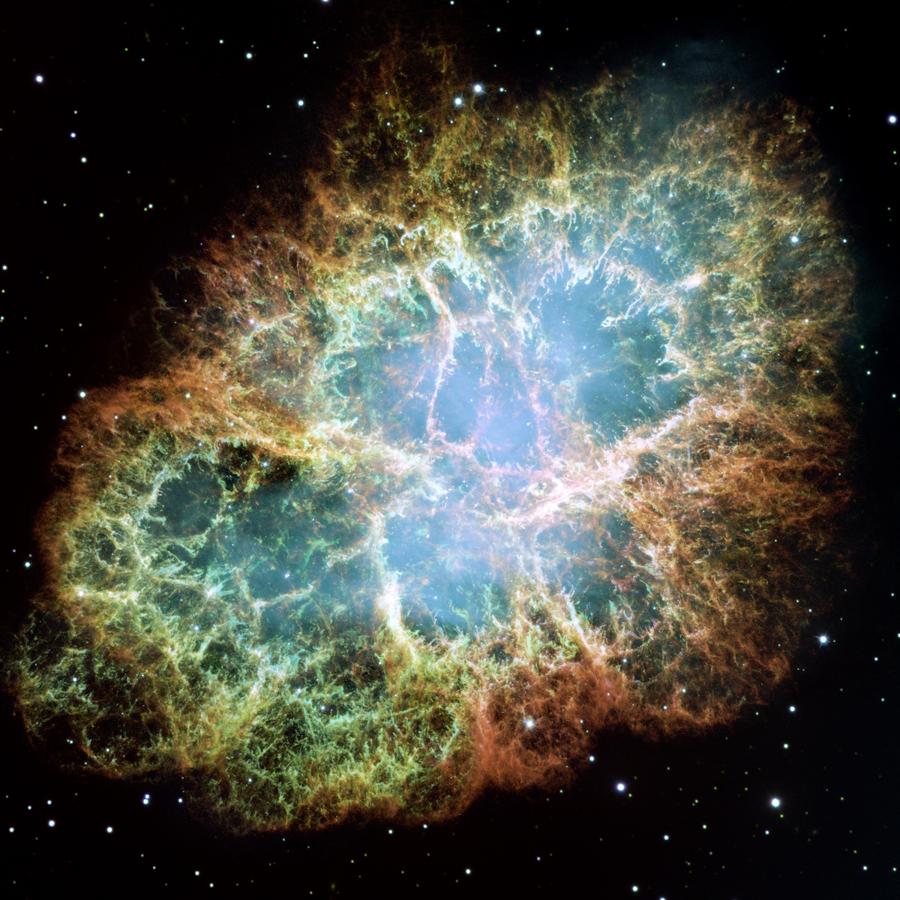
The Crab Nebula is a stellar object about 6,000 to 6,500 light-years away. It can be found in the night sky in the constellation Taurus. The Crab Nebula was created after a supernova exploded in 1054 AD. Since then, it's the most well-known supernova remnant. Yang Wei-te, who recorded the explosion, said it shined for weeks even during the daylight.
The Crab Nebula gets its name from early astronomers who thought it looked like a crab claw. It is about 20 kilometers wide, with more mass than the sun, and spins every 33 milliseconds. This means that a single point on its surface moves 4 million miles per hour.
When the original star collapsed a rapidly spinning neutron star was created. The pulsar releases large amounts of energy, about 100,000 times that of the sun’s power that lights up the nebula. As it emits energy, its’ spinning slows down. Every 30 seconds, the pulsar gives off bursts of radiation, caused by its strong magnetic field ten trillion times stronger than Earth’s radiation.
When we look through telescopes today, we see a large glowing cloud of gas and dust stretching six light-years across space. NASA’s Chandra X-ray Observatory shows tilted rings and bright waves of energy moving away from the nebula, stretching more than a light-year into space. The inner ring is 200 times our solar system's diameter. The bright colors we see are the dust and gases that includes orange hydrogen, blue oxygen, green sulfur, and red doubly ionized oxygen. High-energy particles spin around magnetic field lines, the gas glows, which creates the pattern we see today.
The research we have done so far has helped scientists learn how materials are released from stars to help create planets, life, and new stars. Crab Nebula is very cool and complex, even 1,000 years after its explosion, it is still one of the most powerful and beautiful sights in the universe.
[Sources: Chandra.Harvard.edu; NASA]











Loading Comments...