New Moon Discovered Orbiting Planet Uranus
by Sofia Zapata, age 16
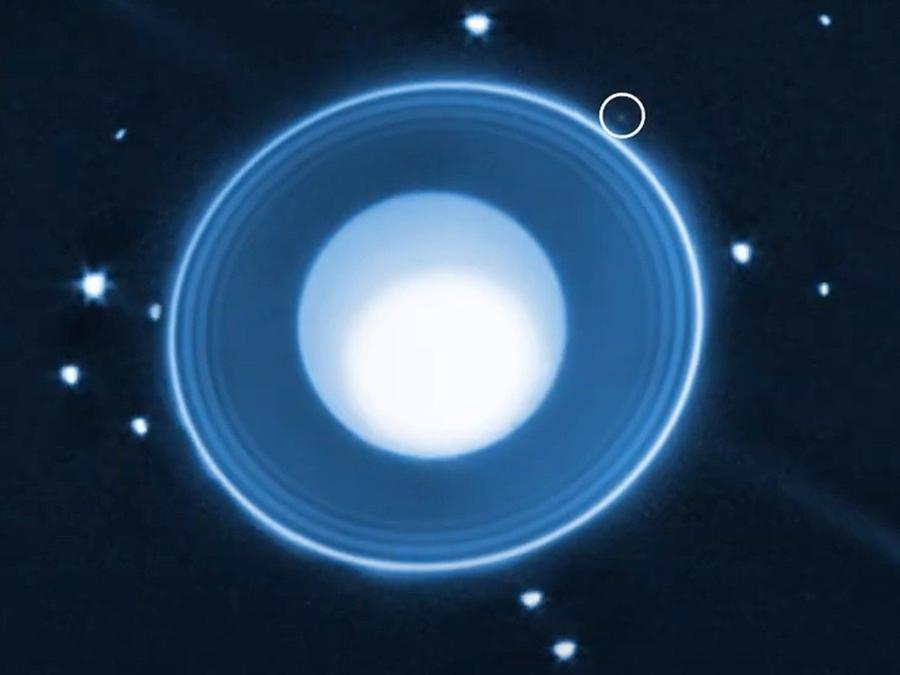
The number of known moons of planet Uranus recently increased to 29. A moon orbiting Uranus was found by the Southwest Research Institute (SwRI) during an observation with NASA’s James Webb Space Telescope.
The discovery of new moons is rare; however, it still occurs from time to time on big planets like Saturn, Jupiter, Neptune, and Uranus. “These planets have many moons, and some are so tiny and faint that we’re still discovering them,” said El Moutamid, a prominent Moroccan astrophysicist at the (SRI). This is why new moons were most likely not visible to Voyager 2 and other telescopes. The new moon was hard to find as it is estimated to be ten kilometers in diameter and about 35,000 miles from Uranus’ center.
Uranus has been described by Voyager 2’s flyby data. On this planet, the creation of its extreme tilt rings came from the rotation on its side, and shed light on the planet’s atmosphere.
Researchers hope this discovery will give new insight into the structures, stability, and history of Uranus’ mysterious rings. Matthew Tiscareno is a member of the SETI Institute and an expert in planetary rings. “No other planet has as many smaller inner moons as Uranus,” said Tiscareno, “and their complex interactions with the rings hint at a chaotic history that blurs the boundary between a ring system and a system of moons.”
The name of the new moon is still under discussion and will be approved by the International Astronomical Union, which normally assigns names to astronomical objects. Astronomers will keep doing research, and this new moon can help them discover new facts about Uranus.
[Sources: NASA; SETI; The New York Times]











Loading Comments...