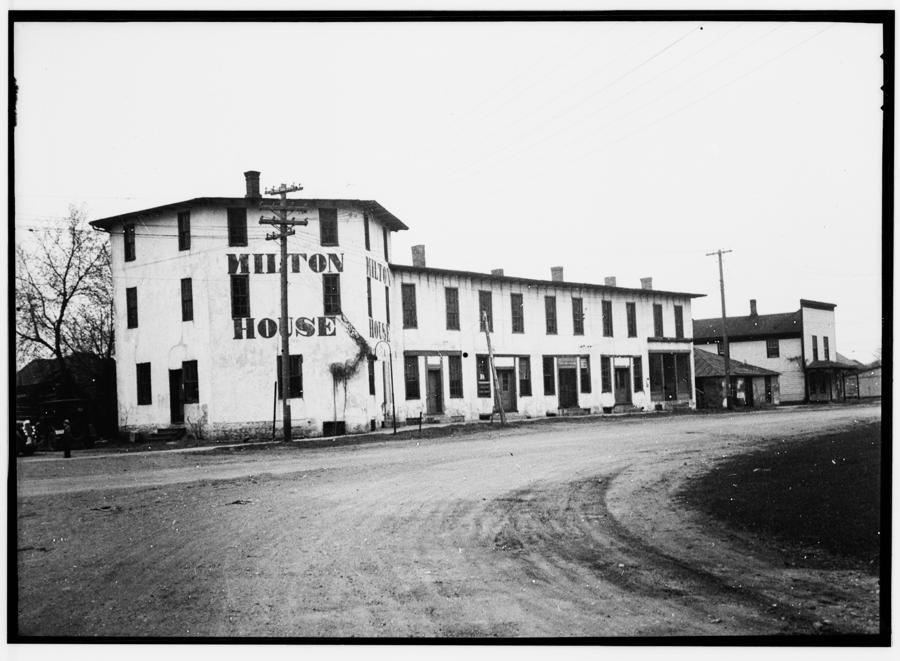
This Strange House in Milton, Wisconsin Was Once a Station on the Underground Railroad
by Ermiyas Abiy, age 10
Many people are familiar with the Underground Railroad and Harriet Tubman, but few are aware of the Milton House. The Milton House was created by Joseph Goodrich, who is often credited with founding the whole town of Milton, Wisconsin.
In 1838, Joseph Goodrich, along with his family and nine others, arrived in what would soon become the Wisconsin town of Milton. Goodrich came from Alfred, New York. He had sold his business and land in Alfred so he could bring his family with him to Wisconsin.
Goodrich ran an inn and a store in two separate framed buildings before they eventually combined in 1844. The structure consisted of a hexagonal, two-story building that served as a stagecoach inn and a five-unit, two-story structure named the Block. The Block offered business rental space on the first floor, as well as rentable living space on the second floor. In 1867, Goodrich and his son Ezra added a third floor to the Block due to the growing and succeeding business. The inn was then renamed to the Milton House.
Goodrich was an abolitionist, and the Milton House became a 'station' on the Underground Railroad. One of the three outer buildings that Goodrich built before the Milton House contains a secret tunnel about 45 feet long. The tunnel leads to the cellar at Milton House, though no one knows how, when, or why it was created. However, it is well documented that it saved at least one slave seeking freedom, Andrew Pratt.
Because of this, the Milton House was considered and certified as an Underground Railroad site by the National Park Service's Network to Freedom program in 1968. At this time, the Milton House is the only certified Underground Railroad site in Wisconsin that is available and open to the public.
After years of neglect, a big part of the Block’s structure collapsed in 1948. To preserve the building, the Milton Historical Society bought the building from the Goodrich family for a single dollar. After six years of hard work, dedication, volunteers, and renovations, the Milton Historical Society finally stabilized and restored the hexagon and the first block of the original structure. In 1954, the newly restored historical sites were reopened to the public. From 1954 to 2006, the Milton House Museum consisted of the hexagon, the first Block, the original cabin out back, and the late 1800s addition to the building, which survived the collapse.
The history, knowledge, and secrets the Milton House holds are fascinating. The trouble the historic building faced makes it even more amazing. The Milton House is a grand and memorable building with a great history.
[Sources: Milton House Museum; Wisconsin Historical Society; City of Milton]











Loading Comments...