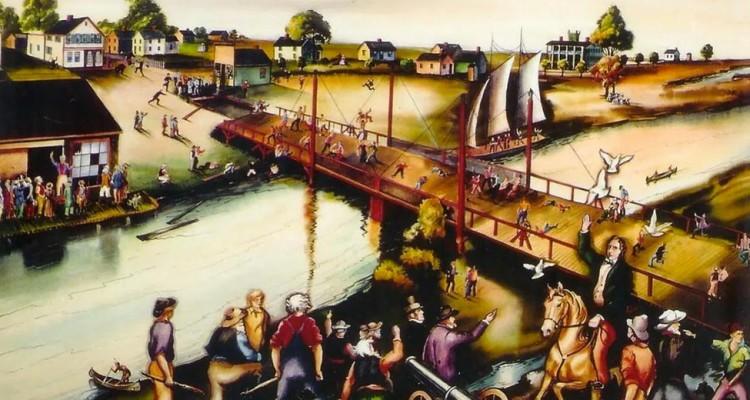
The Infamous Milwaukee Bridge Wars
by Theodore Morrison, age 17
Can you remember the last time you drove across a bridge? You probably cannot. Today, there are many bridges, so you tend to forget most of them. But in Wisconsin history, there was a time when bridges often caused significant conflict. In one famous case, battles were fought over bridges.
Milwaukee is Wisconsin's largest city. And in 1845, the stage was set for the so-called Milwaukee Bridge War. That’s when the cities of Kilbourntown and Walker’s Point were created alongside the pre-existing town of Juneautown, which was founded in 1834. The three towns, all located on the Milwaukee River, were vying for economic dominance in the region.
Conflict was sparked when the two competing settlements of Juneautown and Kilbourntown incorporated in what is now modern-day Milwaukee. Both towns were engaged in an economic stand-off started by the founder of Kilbourntown. As he attempted to advertise Juneautown as a less developed town despite the city holding several significant institutions.
This economic stand-off escalated, and both designed road plans that did not line up with the other city, making bridges harder to make. When one bridge was ordered to be constructed, the cities bickered about cost and maintenance, to the point that the county had to pay for it. Tensions were high, and neither city was going to de-escalate. On May 8, 1845, Kilbourntown residents disassembled part of the county-paid bridge and damaged another. In retaliation, Juneautown residents destroyed a bridge and threatened to attack a dam. This conflict resulted in four out of five of the bridges in the area being destroyed and numerous skirmishes injuring many, some seriously.
Early the next year, the towns made peace, and shortly after formed the city of Milwaukee. The conflict lasted eight months and left permanent scars to the city. Now as we look back into Wisconsin history, we can reflect on the cost and lessons of this conflict, and how we may apply those lessons to our modern world where conflicts seem numerous.
With these lessons from history, we can see the benefits of cooperation and collaboration as we work to overcome simple problems -- like building bridges.
[Sources: Milwaukee Journal Sentinel; Wisconsin Historical Society; UW-Milwaukee]











Loading Comments...