How Photos Made Wisconsin Dells a Must-See Destination
by Arsema Biruk, age 8
The Wisconsin Dells is known as a fun year-round vacation destination for many families. It features a variety of popular tourist attractions, including ski shows, miniature golf, go-karts, and waterparks. However, before the rise of indoor waterparks and amusement parks, the area was famous for its natural scenery along the Wisconsin River.
Wisconsin Dells was originally called Kilbourn City. Initially, the scarcity of hotels and river guides made it hard for tourism to grow. Despite the use of steamboats, Kilbourn City was not a popular destination; however, the artistic vision of one photographer changed the city's future.
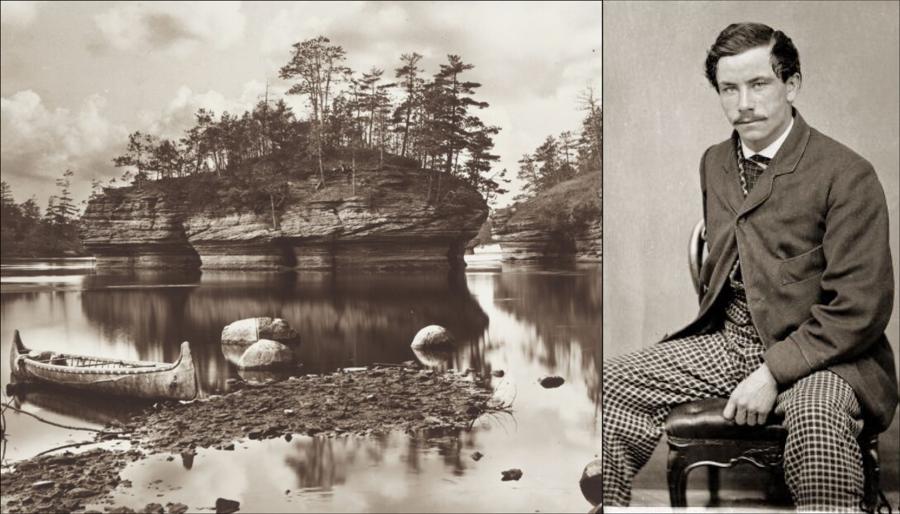
H.H. Bennett was a photographer who helped make the city more attractive to visitors through his images. Bennett was born in Quebec, Canada, and raised in Vermont. When he was 14, Bennett and some family members moved to Wisconsin, settling in Kilbourn. For most of his life, Bennett was a carpenter, but he had a keen eye for Kilbourn’s beautiful natural landscapes.
At the time, there was little demand for photographs of the local scenery. Bennett took advantage of this and used his carpentry skills to build much of his camera equipment. He headed to the countryside and began photographing the Wisconsin River and its distinctive sandstone and rock formations.
Bennett's photos circulated the city and drew some tourists. Nevertheless, he felt that two-dimensional images didn't truly capture the river’s beauty. So, he started creating stereoscopic images, using a technique with two similar photos side by side that, when viewed up close, give a three-dimensional effect. Soon after, Bennett's "3D" photos gained popularity and sold nationwide. As a result, Kilbourn saw an increase in tourism, with more visitors eager to see the scenes from Bennett's photos in person.
In 1875, as tourism boomed, Bennett opened a photography studio named after himself. There, he sold photographic souvenirs like postcards and portraits. Bennett's innovations extended beyond stereoscopic images; he also developed technology that increased the speed of cameras capturing fast-moving scenes. At that time, cameras took minutes to capture a scene, so subjects had to remain still or the photo would turn out blurry. In 1886, with this new technology, Bennett took his most famous photograph, showing the moment when his son jumped across two tall, striking rock formations.
By the 1890s, Bennett's photography career began to decline as camera technology improved and portable cameras became more accessible. Despite the downturn in demand, Bennett kept working in his studio.
H.H. Bennett died in 1908, but his family continued promoting his work. Visitors can explore his impact and history at the H.H. Bennett Studio and Museum in the Wisconsin Dells, which houses many of his original works and tools. From its scenic landscapes to its exciting attractions, Wisconsin Dells remains a vacation spot that creates lasting memories, largely thanks to Bennett’s contributions, which helped shape its reputation today.
[Source: Wisconsin History Highlights]











Loading Comments...