Dane County Launches New Composting Program to Process Food Waste
by Owen Ayite-Atayi, age 17
Food waste is a major concern in the United States. In response, the Dane County Department of Waste & Renewables has partnered with local composting company Purple Cow Organics to launch a county-wide composting initiative.
According to the United States Department of Agriculture (USDA), about 30-40 percent of our food supply nationwide is lost to food waste, which is equivalent to about 130 billion pounds of food and $161 billion for growing, processing, preparing, and transporting food. In Dane County, approximately one-third of all material in the Dane County Landfill consists of food waste.
“We operate a County landfill that accepts over 300,000 tons of materials every year. Over 34 percent of all landfilled items in Dane County are organic materials (food, yard waste, etc.),” said Delaney Gobster, Dane County Department of Waste & Renewables business development and outreach coordinator. “It is our largest single waste stream and the majority of that is wasted food.”
This amount of food waste can damage our economy, society, and environment. First, throwing out food wastes money, time, and labor to initially produce the food, and then requires more energy and labor to properly discard the remains.
Many families in need cannot afford to buy food, while simultaneously literal tons of food waste end up in the landfill each year in Dane County. When organic material breaks down in landfills without oxygen, greenhouse gas methane is generated, polluting our air and environment.
Decreasing the amount of greenhouse gas emissions and conserving landfill space is a priority for Gobster because the Dane County Landfill has nearly reached capacity. Reducing how much food waste enters the landfill is one method to avoid this.
“We’re always innovating and have invested in a Renewable Natural Gas plant that can recycle the methane produced from the landfill, but we can go further. If we can prevent organic waste from being landfilled by composting it instead, we will extend the life of our landfill and reduce emissions,” said Gobster.
This is where the Department of Waste & Renewables’ composting initiative comes into play. According to the department’s website, “Composting is the managed, biological decomposition of organic materials (i.e., food scraps and yard waste) by microorganisms in an oxygen-containing (aerobic) environment.”
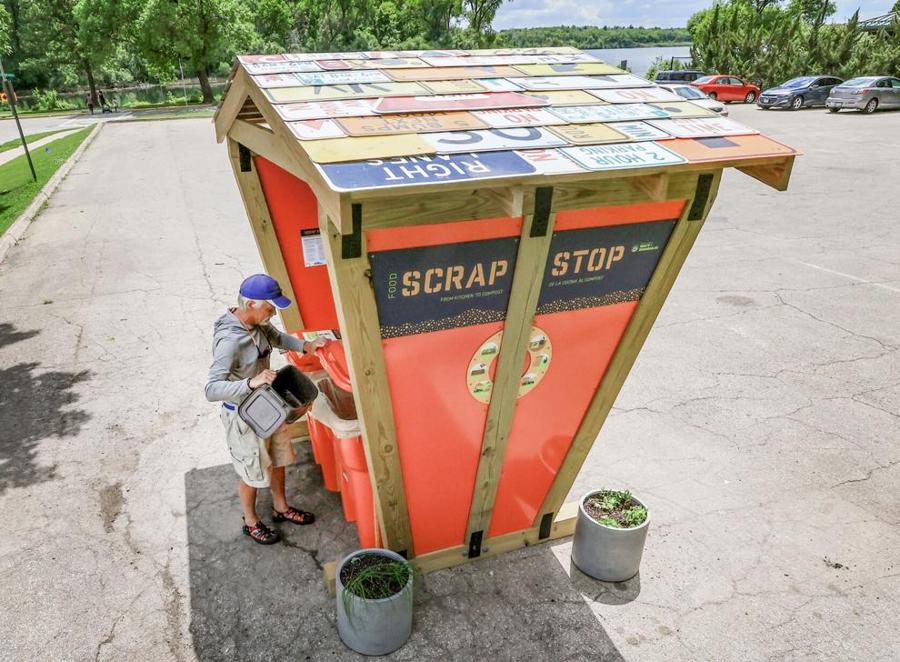
At present, Dane County residents can drop off compostable food waste at the Dane County Landfill and their local farmer’s market. With a $400,000 grant from the U.S. Department of Agriculture, Dane County is installing five new residential compostable food waste drop-off kiosks, or Food Scrap Stops, around the area.
The kiosks were designed in partnership with the Madison Children’s Museum and built by Mount Horeb carpenters Dan Ganch and Josh Bruenig. Four of the five Scrap Stops will be available 24/7 starting June 1st and will be located in and around Madison, at Quarry Skate Park in Middleton, McFarland Public Works, Warner Park, and Henry Vilas Zoo in Madison. An additional drop-off site will be available at Badger Prairie Needs Network in Verona starting August 1st.
Any Dane County resident can use the free kiosks. To eliminate contamination and pests, all Scrap Stops will be locked. Upon completing a brief registration, residents will receive a lock code to access the kiosks at any time. Local restaurants and food service businesses are also encouraged to submit an inquiry regarding food scrap pick-up.
The Department of Waste & Renewables has shared guidelines for what material will be accepted as compost for these drop-off sites. Eggshells, coffee grounds, raw fruits and vegetables, beans, seeds, and grains are all accepted compost. However, residents are asked not to discard prepared food, meat, dairy, liquids, paper, plastic, or other packaging materials at these sites.
The compost will be collected weekly and taken to Purple Cow Organics’ facility in Waunakee, where the food and yard waste will be processed and turned into fertilizer.
“These materials are a community resource that instead of being landfilled, can be turned into compost, and ultimately food for our community,” said Gobster.
Food waste in Dane County is not just about trash, it is about people going hungry while good food is thrown away. Dane County hopes to build a community that is more sustainable. More information about the initiative is available at landfill.danecounty.gov/compost.
[Sources: Dane County Department of Waste & Renewables; The Capital Times; Mount Horeb Mail]











Loading Comments...