UW Researchers Find North America's Oldest Dinosaur
By Camila Cruz, age 17
Earlier this month, the University of Wisconsin Geology Museum announced the finding of a brand new species of dinosaur – one that lived 10 million years earlier than when researchers thought the oldest dinosaurs roamed in North America.
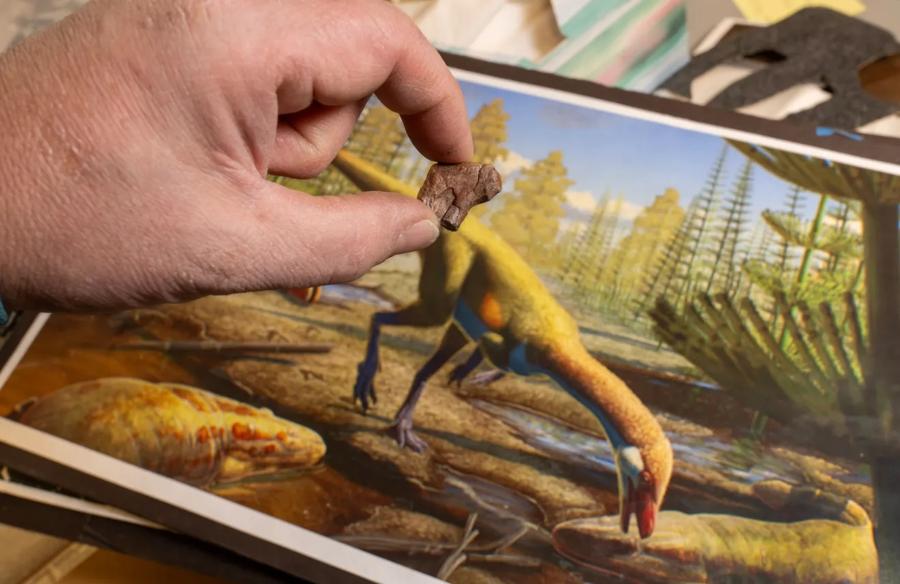
The team from the University of Wisconsin-Madison, co-led by Dr. David Lovelace and graduate student Aaron Kufner, discovered an ankle bone in a Wyoming excavation back in 2013. The bone belonged to a dinosaur the team later named Ahvaytum bahndooiveche. Their findings over the past 12 years were published in the Zoological Journal of the Linnean Society on Jan. 8, 2025.
When dinosaurs emerged has always been a subject of scientific debate. The announcement of this new dinosaur species makes scientists question their understanding of prehistoric life.
The most popular theory has been that dinosaurs first appeared in Gondwana, the southern part of the supercontinent Pangea, before slowly migrating to the northern half called Laurasia. This theory is based mainly on fossil records, however, the discovery of the new dinosaur by UW-Madison paleontologists suggests that dinosaurs were present in the northern hemisphere far earlier. The new fossils dated to approximately 230 million years ago, making it the oldest known Laurasian dinosaur.
“We have, with these fossils, the oldest equatorial dinosaur in the world — it’s also North America’s oldest dinosaur,” said Lovelace, a research scientist at the UW Geology Museum.
The fossil was uncovered in Wyoming, an area that used to be near the equator during the late Triassic period. During this time, around 234 to 232 million years ago, the Earth was going through significant climatic change known as the Carnian pluvial episode. The land was wetter, making it a good place for dinosaurs to live and for new dinosaur species to emerge. Based on the evidence found, the researchers think Ahvaytum lived either during this period or shortly after.
While the discovery doesn’t include a complete skeleton, which is true for most early dinosaurs, there was enough fossil evidence for the team to identify Ahvaytum as a dinosaur. The researchers believe it to be an early relative of the sauropod family. Unlike some of the more famous and much more recent members of this family, the titanosaurs, Ahvaytum bahndooiveche was about one foot tall.
“It was basically the size of a chicken but with a really long tail,” said Lovelace. “We think of dinosaurs as these giant behemoths, but they didn’t start out that way.”
It took 12 years of careful excavation and analysis for the team to finally determine the fossil’s age. The finding was made possible through high-precision radioisotopic dating techniques. Dr. Lovelace’s team also discovered an early dinosaur-like track in even older rocks, further supporting the idea that dinosaurs or their ancestors were present in Laurasia much sooner than previously thought.
“We’re kind of filling in some of this story, and we’re showing that the ideas that we’ve held for so long — ideas that were supported by the fragmented evidence that we had — weren’t quite right,” Lovelace said.
The excavation site was located on ancestral lands of the Eastern Shoshone Tribe and the name ‘Ahvaytum bahndooiveche’ translates to “long ago dinosaur” in the Shoshone language. The name shows the collaborative effort between the UW’s team and seventh-grade students and elders from the Eastern Shoshone Tribe. Amanda LeClair-Diaz, a co-author of the study and a member of the Eastern Shoshone and Northern Arapaho Tribes, said this collaboration represents a shift away from the traditional one-sided research process in which Indigenous communities often have little input.
The first known dinosaur in the northern hemisphere and the first dinosaur named with input from Indigenous communities, Ahvaytum bahndooiveche is a ground-breaking discovery in the field of paleontology and history. For those who would like to see for themselves, the ankle bone is now on display at the University of Wisconsin Geology Museum, at 1215 West Dayton St. The free museum is open to the public from 8:30 am to 4:30 pm on weekdays, and 9:00 am to 1:00 pm on Saturdays
[Sources: Madison Magazine; UW Geology Museum; UW News; WTMJ]











Loading Comments...